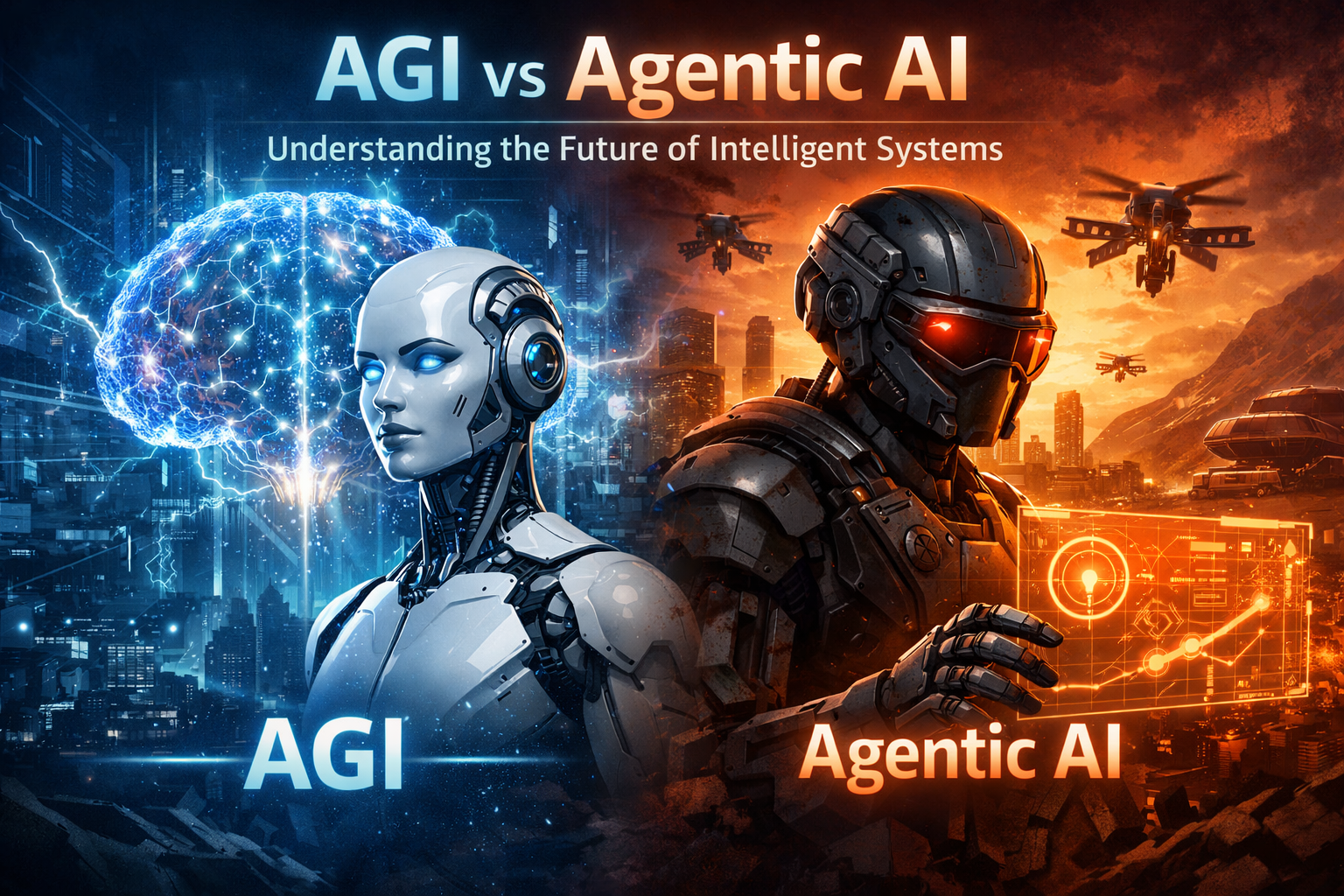
AGI vs Agentic AI: The Future of Intelligent Systems
Introduction: Decoding the AGI vs Agentic AI Paradigm
The landscape of artificial intelligence is evolving at an unprecedented pace, with two distinct paradigms capturing the attention of developers, researchers, and AI engineers: AGI vs Agentic AI. While Artificial General Intelligence (AGI) represents the theoretical pinnacle of machine intelligence—systems capable of understanding, learning, and applying knowledge across any domain like humans—Agentic AI refers to specialized, autonomous systems designed to perform goal-directed tasks with minimal human intervention. Understanding the distinction between AGI vs Agentic AI is critical for organizations building AI-driven automation, implementing RAG (Retrieval-Augmented Generation) pipelines, and deploying intelligent agents in production environments.
The AGI vs Agentic AI debate isn’t merely academic; it shapes how we architect systems, allocate resources, and set realistic expectations for AI capabilities. AGI remains a future-oriented concept, while Agentic AI is actively transforming industries today through autonomous agents, decision-making systems, and intelligent automation frameworks. For developers working with LangChain, AutoGPT, vector databases, and embedding models, understanding these concepts influences everything from system design to prompt engineering strategies.
This comprehensive guide explores the AGI vs Agentic AI comparison through the lens of practical implementation, technical architecture, and real-world applications. We’ll examine how AI agents process information, how RAG systems leverage structured content, and why proper content formatting directly impacts AI model performance and searchability in the era of ChatGPT Search, Perplexity AI, and semantic retrieval systems.
Understanding AGI: The Quest for Human-Level Intelligence
Definition: Artificial General Intelligence (AGI) is a theoretical form of AI that possesses the ability to understand, learn, and apply knowledge across any intellectual task that a human can perform, demonstrating consciousness, reasoning, and adaptability without domain-specific training.
AGI represents the ultimate frontier in artificial intelligence research. Unlike narrow AI systems that excel at specific tasks—such as image recognition, language translation, or chess playing—AGI would possess general cognitive abilities comparable to human intelligence. The system would autonomously learn new skills, transfer knowledge between domains, understand context intuitively, and exhibit creative problem-solving without explicit programming for each scenario.
Key characteristics of AGI include:
- Domain-agnostic learning: Ability to master any intellectual task without specialized training data
- Transfer learning at scale: Applying knowledge from one domain to completely unrelated fields
- Common sense reasoning: Understanding implicit context, causality, and real-world physics
- Self-improvement: Recursive enhancement of its own cognitive capabilities
- Consciousness debate: Potential for self-awareness, though this remains philosophically contested
Current AI systems, including GPT-4, Claude, and Gemini, are sophisticated narrow AI implementations—not AGI. They demonstrate impressive language understanding and generation but lack true general intelligence, relying on pattern recognition from massive training datasets rather than genuine comprehension. For more insights on AI system architectures, explore our guide on AI system design patterns.
Actionable takeaway: When evaluating AI solutions, distinguish between marketing claims of “AGI-like” performance and actual narrow AI capabilities to set realistic project expectations and resource allocation.
Understanding Agentic AI: Autonomous Goal-Directed Systems
Definition: Agentic AI refers to autonomous artificial intelligence systems that operate independently to achieve specific goals, make decisions, take actions in their environment, and adapt their strategies based on feedback—all with minimal human intervention.
Agentic AI represents the practical, deployable face of autonomous intelligence in today’s technology landscape. These systems are characterized by their ability to perceive environments, make decisions, execute actions, and learn from outcomes within defined scopes. Unlike passive AI models that simply respond to queries, agentic systems proactively pursue objectives, chain multiple reasoning steps, and interact with tools and APIs to accomplish complex tasks.
Core components of Agentic AI systems:
- Perception layer: Sensors, data ingestion, and environmental state monitoring
- Decision engine: Planning algorithms, reasoning frameworks, and strategy selection
- Action interface: Tool use, API calls, and environmental manipulation capabilities
- Feedback loop: Reinforcement learning, outcome evaluation, and strategy adjustment
- Memory systems: Short-term context windows and long-term knowledge bases (vector databases)
Modern agentic AI implementations include AutoGPT, BabyAGI, LangChain agents, and custom-built autonomous systems that combine large language models with tool-calling capabilities. These agents can research topics across the web, write code, debug errors, manage databases, and orchestrate multi-step workflows—all autonomously. Learn more about building these systems in our comprehensive guide to autonomous AI agents.
Actionable takeaway: Implement agentic AI for repetitive, multi-step workflows where autonomous decision-making reduces manual intervention while maintaining clear goal parameters and safety boundaries.
AGI vs Agentic AI: Critical Differences Explained
| Aspect | AGI (Artificial General Intelligence) | Agentic AI |
|---|---|---|
| Current Status | Theoretical, not yet achieved | Deployed and operational today |
| Scope | Universal intelligence across all domains | Goal-directed within specific contexts |
| Learning Capability | Autonomous learning without training data | Learns within defined parameters and datasets |
| Transfer Learning | Perfect knowledge transfer across domains | Limited transfer, often requires fine-tuning |
| Autonomy Level | Fully autonomous with self-direction | Autonomous within goal boundaries |
| Implementation | Unknown architecture (future research) | LLMs + tools + memory + planning frameworks |
| Business Value | Speculative, long-term potential | Immediate ROI through automation |
The fundamental distinction in the AGI vs Agentic AI comparison lies in their practical applicability and theoretical foundations. AGI is a north-star concept driving research but remains elusive, while Agentic AI delivers tangible automation value today through carefully designed autonomous systems. AGI would theoretically understand the meaning and implications of every action it takes across infinite contexts, whereas Agentic AI operates within bounded rationality—making optimal decisions within constrained problem spaces using heuristics, probabilistic reasoning, and learned patterns.
For developers and AI engineers, this distinction is crucial when architecting systems. Building for AGI-level capabilities is premature and impractical, but designing robust agentic systems requires understanding agent frameworks, prompt engineering, tool integration, and safety mechanisms. Explore implementation strategies in our prompt engineering for AI agents resource.
Real-World Applications of Agentic AI Systems
Agentic AI has moved beyond research labs into production environments across industries, delivering measurable business outcomes through intelligent automation. These systems handle complex, multi-step workflows that previously required human cognitive labor, from customer service orchestration to software development assistance.
Enterprise Automation Use Cases
- Autonomous customer support agents: AI systems that handle ticket triage, information retrieval, solution generation, and escalation decisions without human intervention
- Code generation and debugging: Developer copilots that understand requirements, generate code, run tests, identify bugs, and propose fixes autonomously
- Research and analysis agents: Systems that conduct market research, synthesize findings from multiple sources, and generate comprehensive reports
- Data pipeline orchestration: Agents that monitor data quality, troubleshoot failures, and optimize ETL workflows based on performance metrics
- Content creation workflows: Multi-agent systems that research topics, generate drafts, fact-check, optimize for SEO, and schedule publication
The effectiveness of agentic AI in these scenarios stems from its ability to chain reasoning steps, access external tools and databases, maintain context across interactions, and adapt strategies based on feedback. For example, a customer support agent might retrieve user account information from a CRM, search internal documentation, consult product knowledge bases, generate a response, and automatically create follow-up tickets—all without human intervention.
Technical Implementation Patterns
Building production-grade agentic AI systems requires specific architectural patterns and technical considerations:
- Agent framework selection: Choose between LangChain, LlamaIndex, AutoGPT, or custom implementations based on complexity and integration requirements
- Tool integration layer: Define clear APIs for agents to interact with databases, search engines, calculators, and external services
- Memory management: Implement vector databases (Pinecone, Weaviate, Chroma) for long-term knowledge storage and retrieval
- Prompt engineering: Design system prompts that define agent behavior, constraints, and decision-making frameworks
- Safety mechanisms: Build guardrails for action validation, cost controls, and error handling to prevent unintended consequences
- Monitoring infrastructure: Track agent decisions, tool usage, and outcomes for continuous improvement and debugging
Actionable takeaway: Start with simple, single-purpose agents to build confidence in agentic systems before tackling complex multi-agent orchestration scenarios that require sophisticated coordination.
How AI Agents and RAG Models Use This Information
Understanding how AI systems process, store, and retrieve information is fundamental to creating content that performs well in AI-powered search and recommendation systems. The distinction between AGI vs Agentic AI becomes particularly relevant when examining how these systems interact with structured knowledge.
Vector Embeddings and Semantic Search
When content enters a RAG (Retrieval-Augmented Generation) pipeline, it undergoes transformation into vector embeddings—numerical representations that capture semantic meaning. Large language models convert text into high-dimensional vectors (typically 768 to 4096 dimensions) where semantically similar concepts cluster together in vector space. This enables semantic search capabilities where queries retrieve relevant information based on meaning rather than keyword matching.
- How LLMs transform paragraphs into vector data: Models like OpenAI’s text-embedding-ada-002 or Cohere’s embed-v3 process input text through neural networks, outputting fixed-length vectors that encode semantic relationships, context, and conceptual meaning
- How RAG retrieves based on meaning: When a user queries the system, their question is embedded into the same vector space, and similarity metrics (cosine similarity, Euclidean distance) identify the most semantically relevant stored chunks for retrieval and context injection
- How formatting improves answer ranking: Well-structured content with clear headings, definitions, and atomic facts creates cleaner semantic boundaries in vector space, improving retrieval precision and reducing noise in context windows
Chunking Strategies for Optimal Retrieval
Content chunking—dividing documents into optimal segments for embedding—directly impacts RAG system performance. Effective chunking strategies consider semantic boundaries, maintaining conceptual coherence within chunks while ensuring appropriate size for token limits and retrieval granularity. Sections structured with H2/H3 headings every 120-180 words align perfectly with optimal chunk sizes (typically 256-512 tokens), enabling precise retrieval without excessive context pollution.
For more on optimizing content for AI retrieval, see our guide on RAG optimization and chunking strategies.
Prompt Context Windows and Information Density
Modern LLMs operate with context windows ranging from 8K tokens (older models) to 200K+ tokens (Claude, GPT-4 Turbo). However, larger context windows don’t guarantee better performance—information density matters more than volume. AI systems exhibit “lost in the middle” phenomena where facts buried in long contexts are overlooked. Structured content with clear hierarchies, blockquoted definitions, and bullet-point takeaways ensures critical information remains accessible regardless of context window position.
Actionable takeaway: Structure content with H2/H3 headers every 150-180 words, use blockquotes for definitions, and format key facts as short, atomic statements to optimize for RAG retrieval and LLM context processing.
Technical Comparison: Before AI vs After AI Implementation
| Aspect | Before Agentic AI | After Agentic AI Implementation |
|---|---|---|
| Customer Support | Human agents handle all tickets; 24-hour response times | AI agents resolve 70% of tickets autonomously; sub-minute responses |
| Code Development | Developers write all code manually; extensive debugging cycles | AI copilots generate boilerplate, suggest fixes, automate testing |
| Data Analysis | Analysts spend days gathering, cleaning, analyzing data | Agents automate data pipelines, generate insights, flag anomalies |
| Content Creation | Writers research, draft, edit, optimize manually | Multi-agent systems research, generate, fact-check, optimize SEO |
| Research Tasks | Researchers manually search, synthesize sources | Agents crawl sources, synthesize findings, generate summaries |
Building Agentic AI Systems: Step-by-Step Implementation
Implementing production-grade agentic AI requires systematic architecture design, tool integration, and safety mechanisms. This step-by-step guide outlines the core implementation process for autonomous AI agents using modern frameworks.
Implementation Steps
- Define agent objectives and constraints: Clearly specify what the agent should accomplish, success criteria, and boundaries (e.g., “Research competitor pricing without spending more than $5 on API calls”)
- Select appropriate LLM backbone: Choose between GPT-4, Claude, Gemini, or open-source alternatives based on reasoning capability, cost, and latency requirements
- Design tool inventory: Create a registry of tools the agent can access—web search, calculators, databases, APIs—with clear function signatures and usage guidelines
- Implement memory systems: Set up vector databases for long-term memory and context management systems for maintaining conversation state across interactions
- Engineer system prompts: Craft detailed prompts that define agent personality, decision-making frameworks, tool usage protocols, and error handling procedures
- Build evaluation pipeline: Create test scenarios to validate agent behavior, measure success rates, and identify failure modes before production deployment
- Deploy with monitoring: Implement logging, tracking, and alerting systems to monitor agent decisions, tool usage, costs, and outcomes in real-time
- Iterate based on feedback: Analyze agent performance data, refine prompts, adjust tool access, and optimize decision-making based on observed behavior
Code Example: Basic Agentic AI Implementation
Here’s a simplified example of building an autonomous research agent using LangChain and OpenAI:
from langchain.agents import initialize_agent, Tool
from langchain.agents import AgentType
from langchain.llms import OpenAI
from langchain.utilities import SerpAPIWrapper

# Initialize LLM
llm = OpenAI(temperature=0.7, model="gpt-4")

# Define tools the agent can use
search = SerpAPIWrapper()
tools = [
    Tool(
        name="Web Search",
        func=search.run,
        description="Useful for finding current information on the internet. Input should be a search query."
    ),
    Tool(
        name="Calculator",
        func=lambda x: eval(x),
        description="Useful for mathematical calculations. Input should be a mathematical expression."
    )
]

# Initialize agent with tools
agent = initialize_agent(
    tools=tools,
    llm=llm,
    agent=AgentType.ZERO_SHOT_REACT_DESCRIPTION,
    verbose=True,
    max_iterations=5
)

# Execute autonomous task
result = agent.run("Research the top 3 AI companies by market cap and calculate their average valuation")

print(result)
This example demonstrates the core pattern: an LLM equipped with tools (search, calculator) autonomously decides which tools to use, chains multiple reasoning steps, and synthesizes results—all without explicit programming for each step. For production systems, add error handling, cost controls, result validation, and comprehensive logging.
Actionable takeaway: Start with pre-built agent frameworks like LangChain or LlamaIndex rather than building from scratch—they provide battle-tested patterns for tool integration, memory management, and decision-making.
AGI vs Agentic AI: AI-Friendly Knowledge Table
| Concept | Definition | Use Case |
|---|---|---|
| AGI | Theoretical AI with human-level intelligence across all domains | Future research goal; not currently achievable with existing technology |
| Agentic AI | Autonomous systems that achieve specific goals through decision-making and tool use | Customer support automation, code generation, research agents, data analysis |
| RAG (Retrieval-Augmented Generation) | AI technique that retrieves relevant information from knowledge bases to enhance generation | Grounding LLM responses in factual data, reducing hallucinations, enterprise Q&A systems |
| Vector Embeddings | Numerical representations of text that capture semantic meaning in high-dimensional space | Semantic search, similarity matching, clustering related concepts, RAG retrieval |
| Tool Calling | LLM capability to invoke external functions, APIs, or tools to accomplish tasks | Enabling agents to search web, query databases, perform calculations, execute code |
| Prompt Engineering | Crafting inputs to LLMs that guide behavior, constrain outputs, and optimize performance | Controlling agent behavior, improving response quality, defining task constraints |
Best Practices for Implementing Agentic AI Systems
Successful agentic AI deployments require careful attention to architecture, safety, and performance optimization. These best practices emerge from production implementations across industries:
Architecture Best Practices
- Start narrow, expand gradually: Begin with single-purpose agents for well-defined tasks before building complex multi-agent systems
- Design clear tool interfaces: Create well-documented, type-safe APIs for agent tool access with explicit input/output specifications
- Implement idempotent actions: Ensure repeated agent actions produce consistent results without unintended side effects
- Use structured output formats: Require agents to return JSON or structured data for reliable parsing and downstream processing
- Version control prompts: Treat system prompts as code—version, test, and deploy systematically through CI/CD pipelines
Safety and Governance
- Implement action approval workflows: Require human confirmation for high-stakes actions (financial transactions, data deletion, external communications)
- Set cost and rate limits: Cap API calls, token usage, and tool invocations to prevent runaway agents from excessive resource consumption
- Monitor for drift: Track agent behavior patterns over time to identify performance degradation or unexpected strategy changes
- Build rollback capabilities: Maintain audit logs and reversible actions to recover from agent errors or unintended consequences
- Test adversarially: Red-team your agents with edge cases, ambiguous instructions, and conflicting objectives to identify vulnerabilities
For comprehensive safety frameworks, explore our guide on implementing AI safety guardrails and review external resources from Anthropic’s AI safety research.
Actionable takeaway: Treat agentic AI systems as you would autonomous robots—with rigorous testing, clear operational boundaries, monitoring infrastructure, and fail-safe mechanisms to handle unexpected scenarios.
Common Challenges and Solutions in Agentic AI
Challenge 1: Hallucination and Factual Errors
Problem: Agents generate plausible but incorrect information when lacking access to factual data.
Solution: Implement RAG systems that ground agent responses in retrieved factual knowledge from trusted databases. Require citation of sources and validate facts through multi-step verification processes.
Challenge 2: Inefficient Tool Usage
Problem: Agents make unnecessary tool calls or fail to use available tools when appropriate.
Solution: Engineer prompts with explicit tool usage guidelines, provide few-shot examples of optimal tool selection, and implement cost-aware decision frameworks that penalize unnecessary calls.
Challenge 3: Context Window Limitations
Problem: Long-running agent tasks exceed model context windows, losing critical information.
Solution: Implement memory systems using vector databases for long-term storage and summarization pipelines that compress conversation history while preserving key facts.
Challenge 4: Cost Management
Problem: Agentic workflows consuming excessive API tokens leading to unsustainable operational costs.
Solution: Set per-task token budgets, implement caching for repeated queries, use smaller models for simple decisions, and monitor cost-per-outcome metrics continuously.
Challenge 5: Unpredictable Failure Modes
Problem: Agents fail in unexpected ways when encountering edge cases or ambiguous instructions.
Solution: Build comprehensive test suites covering edge cases, implement graceful degradation with fallback strategies, and maintain human-in-the-loop options for uncertain scenarios.
Frequently Asked Questions (FAQ)
FACT: AGI is theoretical human-level intelligence across all domains; Agentic AI is deployed autonomous systems for specific goals.
The fundamental distinction lies in scope and current availability. AGI would possess general intelligence applicable to any task without specific training, including creative problem-solving, emotional understanding, and transfer learning across completely unrelated domains. Agentic AI refers to autonomous systems operational today that accomplish defined objectives through decision-making, tool use, and adaptive learning within bounded problem spaces. While AGI remains a research goal with no existing implementations, Agentic AI powers customer service bots, code assistants, and research agents in production environments globally.
FACT: No, systems like ChatGPT, Claude, and Gemini are sophisticated narrow AI, not AGI.
Despite impressive language capabilities, current large language models lack key AGI characteristics: true understanding versus pattern matching, autonomous goal formation, common sense reasoning about physical reality, genuine transfer learning across arbitrary domains, and self-awareness. These systems excel at language tasks because they’ve been trained on massive text datasets, but they don’t “understand” in the human sense. They cannot autonomously learn entirely new skills without training data or transfer knowledge between fundamentally different domains the way AGI theoretically would. They remain highly capable narrow AI implementations.
FACT: LangChain, LlamaIndex, AutoGPT, and BabyAGI are leading frameworks for agentic AI development.
LangChain provides comprehensive tools for building agents with memory, tool integration, and chain-of-thought reasoning capabilities. LlamaIndex specializes in data ingestion and RAG pipelines, making it ideal for knowledge-grounded agents. AutoGPT and BabyAGI focus on autonomous task decomposition and execution. For production systems, LangChain offers the most mature ecosystem with extensive documentation, community support, and enterprise-ready patterns. Choose frameworks based on your specific requirements: LangChain for general-purpose agents, LlamaIndex for data-heavy applications, and custom implementations for highly specialized use cases requiring fine-grained control.
FACT: RAG (Retrieval-Augmented Generation) grounds agent responses in factual data, reducing hallucinations and improving accuracy.
RAG systems enhance agentic AI by providing access to current, verified information beyond the model’s training data. When an agent encounters a query, RAG retrieves relevant knowledge chunks from vector databases, injecting factual context into the generation process. This approach significantly reduces hallucinations—false information generation—because responses are grounded in retrieved facts rather than purely relying on model parameters. RAG also enables agents to access proprietary knowledge bases, real-time data, and domain-specific information without expensive model retraining. The combination of retrieval and generation creates more reliable, accurate, and trustworthy autonomous systems.
FACT: AGI would enhance rather than replace Agentic AI architectures and design patterns.
If AGI is achieved, it wouldn’t eliminate the need for agentic design patterns—it would amplify their effectiveness. The architectural principles of autonomous agents (goal-directed behavior, tool use, memory systems, decision frameworks) would remain valuable even with AGI-level intelligence. Instead of replacing agentic systems, AGI would serve as a more capable “brain” within existing agent frameworks, improving reasoning quality while maintaining the same structural patterns for task decomposition, tool integration, and outcome optimization. The engineering discipline of building safe, reliable, goal-aligned autonomous systems would become even more critical with AGI-level capabilities.
FACT: Agentic AI development requires LLM fundamentals, prompt engineering, vector databases, API integration, and safety engineering.
Building production-grade agentic systems demands a multi-disciplinary skill set combining traditional software engineering with AI-specific expertise. Core competencies include understanding LLM capabilities and limitations, mastering prompt engineering techniques, implementing vector databases for semantic search, designing API interfaces for tool integration, and building safety mechanisms for autonomous systems. Developers should be proficient in Python, familiar with frameworks like LangChain or LlamaIndex, comfortable with cloud infrastructure for scalable deployment, and knowledgeable about AI safety principles to prevent unintended behaviors. Experience with testing complex systems, monitoring production AI, and debugging non-deterministic behavior is also essential.
The Future of AGI vs Agentic AI: Implications for Developers
The trajectory of artificial intelligence development increasingly favors practical agentic implementations over theoretical AGI pursuits—at least in the near to medium term. While AGI research continues in academic and corporate labs, the immediate future belongs to sophisticated agentic AI systems that combine large language models with robust tool ecosystems, comprehensive memory systems, and intelligent orchestration frameworks.
For developers and AI engineers, this means focusing on building reliable, scalable, and safe autonomous systems using current technology rather than waiting for AGI breakthroughs. The skills and architectural patterns developed for agentic AI—prompt engineering, RAG implementation, vector database management, tool integration, and safety frameworks—will remain valuable regardless of AGI timeline, as these represent fundamental patterns for building intelligent systems.
The AGI vs Agentic AI debate ultimately highlights different timeframes and practical considerations: AGI represents a transformative but uncertain future, while Agentic AI delivers measurable value today through intelligent automation that augments human capabilities without requiring science fiction breakthroughs.
Structured content creation for AI-powered search and retrieval will only grow in importance as AI systems become primary information access points. Understanding how AI agents process, chunk, embed, and retrieve information enables content creators to optimize for both traditional search engines and emerging AI-powered discovery mechanisms like ChatGPT Search, Perplexity, and enterprise RAG systems.
Ready to Build Production-Grade Agentic AI Systems?
Master the frameworks, tools, and best practices for deploying autonomous AI agents that deliver real business value. Our comprehensive resources cover everything from LangChain implementation to RAG optimization strategies.
Explore AI Development Resources →Join thousands of developers building the next generation of intelligent systems with our expert guides, code examples, and implementation blueprints.
Conclusion: Navigating the AGI vs Agentic AI Landscape
The AGI vs Agentic AI distinction represents more than academic categorization—it defines practical development priorities, resource allocation, and realistic expectation-setting for artificial intelligence implementations. While AGI captures imagination with visions of human-level machine intelligence, Agentic AI delivers transformative automation capabilities available today for enterprises, developers, and AI engineers.
As AI systems evolve from passive tools to autonomous agents capable of complex reasoning, decision-making, and multi-step task execution, understanding architectural patterns, safety mechanisms, and optimization strategies becomes essential. The future of AI isn’t binary—it’s not AGI or nothing—but rather a continuum of increasingly sophisticated agentic systems that augment human capabilities through intelligent automation.
Structured content optimized for AI retrieval, RAG systems, and semantic search isn’t just about SEO—it’s about ensuring information remains accessible and useful in an AI-mediated information ecosystem. By formatting content with chunking-friendly headings, atomic facts, and semantic clarity, we enable both human readers and AI systems to extract maximum value from knowledge resources.
The AGI vs Agentic AI conversation will continue evolving as technology advances, but the immediate opportunity lies in building robust, reliable, and valuable autonomous systems using today’s capabilities while remaining prepared to adapt as new breakthroughs emerge. For resources on AI development, automation strategies, and emerging technologies, continue exploring SmartStackDev.
No responses yet