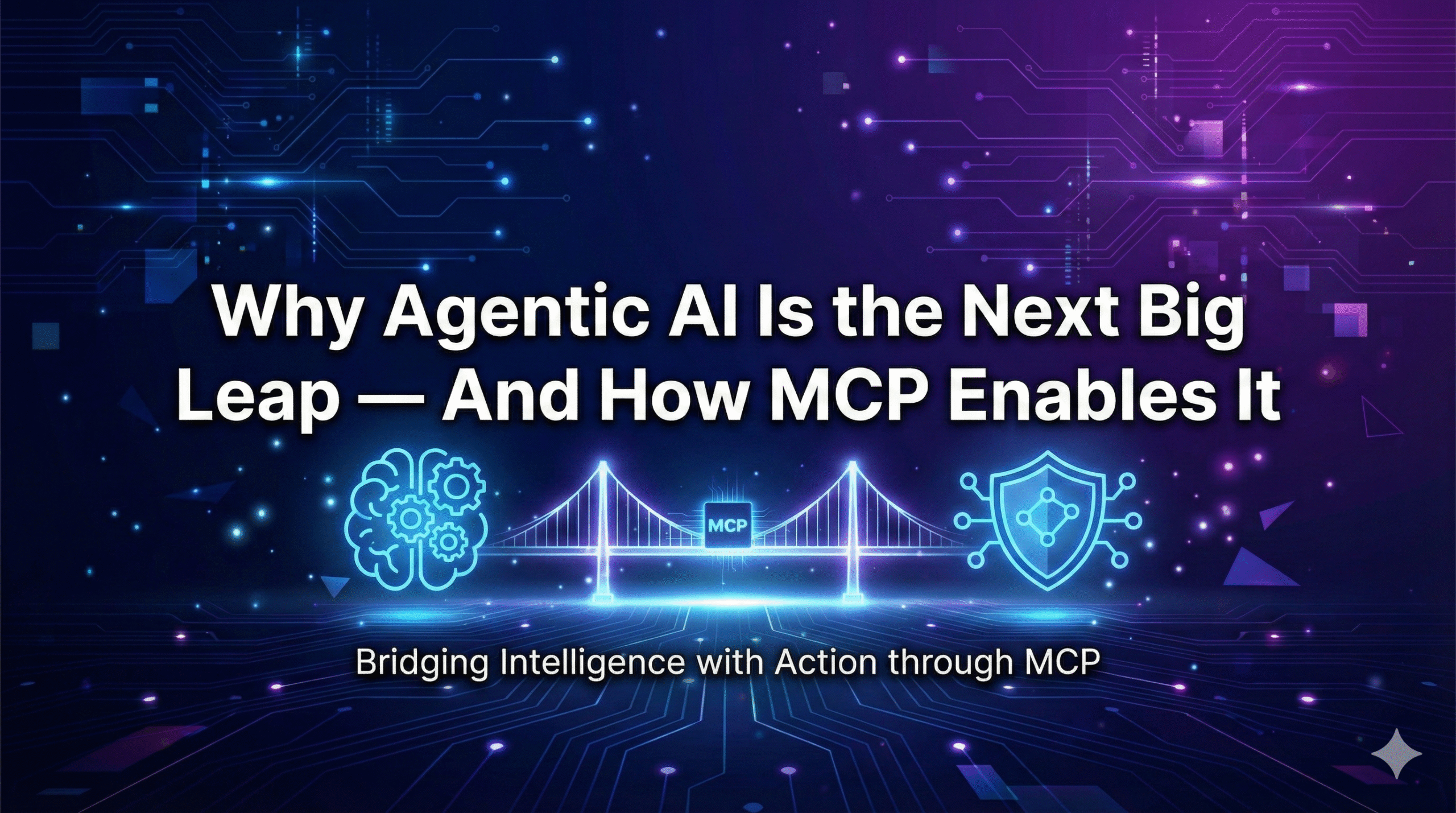
Agentic AI’s Next Big Leap — How MCP Enables It
Introduction: From Assistive to Autonomous AI
We are witnessing a fundamental transformation in artificial intelligence that will define the next decade of enterprise technology. Agentic AI—autonomous systems capable of pursuing goals, making decisions, and taking actions without constant human guidance—represents the next evolutionary leap beyond today’s chatbots and copilots. While traditional AI responds to prompts and waits for the next instruction, agentic AI systems proactively work toward objectives, coordinate across multiple tools and data sources, adapt strategies based on outcomes, and execute complete workflows end-to-end.
This shift from reactive to proactive AI is accelerating faster than most anticipated. Industry analysts project the agentic AI market will surge from $7.8 billion today to over $52 billion by 2030, while Gartner predicts that 40% of enterprise applications will embed AI agents by the end of 2026—up from less than 5% in 2025. OpenAI co-founder Greg Brockman declared 2025 “the year of AI agents,” and while adoption faced challenges, the infrastructure foundations are now solidifying. Major technology leaders from Oracle, AWS, Cisco, and Google unanimously identify 2026 as the inflection point where agentic AI transitions from experimental pilots to operational reality.
But there’s a critical challenge: agentic AI systems cannot operate effectively without standardized connectivity to the data, tools, and context they need.
This is where Model Context Protocol (MCP) becomes transformative.
. Released by Anthropic in November 2024 and donated to the Linux Foundation’s Agentic AI Foundation in December 2025, MCP has achieved unprecedented adoption—97 million monthly SDK downloads, 10,000+ active servers, and support from OpenAI, Google DeepMind, Microsoft, and every major AI platform. MCP solves the N×M integration complexity that previously limited AI agents, providing the “connective tissue” that transforms theoretical agent capabilities into practical enterprise automation. This comprehensive guide explores why agentic AI represents the next paradigm shift in technology, how MCP makes autonomous agents possible at scale, and what organizations must do now to capitalize on this transformation before competitors establish insurmountable advantages.What Makes Agentic AI Different: From Reactive to Proactive Intelligence
Definition: Agentic AI refers to autonomous artificial intelligence systems that independently pursue goals through multi-step reasoning, dynamic tool use, contextual memory, and adaptive decision-making—moving beyond simple request-response patterns to proactive, goal-directed behavior that executes complete workflows without constant human intervention.
Traditional AI systems operate in a fundamentally reactive mode. ChatGPT waits for your prompt, generates a response, and stops. GitHub Copilot suggests code when you start typing but takes no independent action. These systems are powerful assistants but remain passive tools requiring continuous human direction. Agentic AI breaks this limitation by introducing autonomous operation toward defined objectives, fundamentally changing the human-AI relationship from command-and-control to delegation and oversight.
The core distinction lies in four transformative capabilities that traditional AI lacks. First, goal-directed reasoning where agents break down high-level objectives into actionable plans and execute them sequentially. Second, dynamic tool use where agents discover, select, and invoke appropriate tools from available options based on the current context. Third, contextual memory that maintains state across interactions, learning from outcomes and adapting strategies over time. Fourth, autonomous decision-making where agents evaluate options, handle errors, and adjust approaches without waiting for human input at every step.
- Multi-Step Planning: Agents decompose complex tasks into executable sequences with dependencies, checkpoints, and fallback strategies
- Real-Time Adaptation: Continuously monitor progress, detect failures, diagnose issues, and attempt alternative approaches automatically
- Cross-System Coordination: Orchestrate actions across multiple platforms, services, and data sources to accomplish end-to-end workflows
- Context-Aware Decision Making: Consider business rules, user preferences, historical outcomes, and environmental factors when choosing actions
- Collaborative Behavior: Coordinate with other agents, delegate subtasks to specialists, and escalate complex decisions to human overseers
- Continuous Operation: Work autonomously for hours or days toward long-term objectives, not just single interactions
- Self-Improvement: Learn from successful and failed attempts to optimize future performance without retraining base models
Consider a practical example: a traditional AI assistant might answer “How do I schedule a team meeting?” with suggestions. An agentic AI system would check your calendar for availability, analyze team members’ schedules, identify optimal times, send calendar invites, book a conference room, prepare an agenda from meeting objectives, and send reminder notifications—all autonomously based on your stated goal of scheduling the meeting. This shift from suggestion to execution represents the transformative power of agency. Explore more about AI agent architecture patterns that enable autonomous behavior.
Why 2026 Is the Inflection Point for Agentic AI Adoption
Multiple converging forces position 2026 as the year agentic AI transitions from pilot programs to production deployments at enterprise scale. Technology leaders across industries report unanimous shifts in customer demands from “what is possible” to “what can we operationalize”—signaling maturity beyond experimentation. Oracle’s Peter Guerra observes that federal and commercial customers are modernizing data assets specifically to enable context-aware agentic systems, while AWS, Cisco, and Google all launched major agentic platforms in late 2025 targeting 2026 enterprise adoption.
The business case for agentic AI has crystalized through proven deployments delivering measurable outcomes. Healthcare organizations like Easterseals reduced denial rates by 22% and cut accounts receivable days by 32% using autonomous agents for claims processing. Walmart’s AI Super Agent analyzes 500 million daily data points across point-of-sale, weather, and traffic systems to achieve 94% demand forecast accuracy. Power Design’s HelpBot automated 1,000+ hours of repetitive IT work through credential resets, device monitoring, and intelligent escalation. These aren’t pilot metrics—they’re production results demonstrating consistent patterns of 20-40% cost reduction and 50-90% speed improvements.
- Model Capability Maturation: GPT-5, Claude 4.5, and Gemini 2.0 demonstrate significantly improved planning, reasoning, and tool use capabilities essential for reliable agents
- Infrastructure Standardization: MCP’s rapid adoption provides the missing connectivity layer that previously required months of custom integration work
- Proven Business Value: Early deployments demonstrate consistent ROI patterns making budget justification straightforward for enterprise leaders
- Vendor Ecosystem Maturity: Major cloud providers (AWS, Azure, GCP) now offer managed agentic platforms reducing deployment complexity
- Regulatory Clarity: Frameworks like the EU AI Act provide guidelines for responsible autonomous AI deployment
- Talent Availability: Universities and professional programs now offer agentic AI development training creating larger talent pools
- Competitive Pressure: McKinsey reports only 1% of organizations have mature AI strategies—early adopters gain insurmountable advantages
- Economic Conditions: Organizations seek operational efficiency gains and AI offers the most compelling ROI of available technology investments
Perhaps most significantly, the shift in developer sentiment from skepticism to adoption signals readiness. Anthropic CEO Dario Amodei projects that “software engineering will be completely obsolete in 6-12 months” as agents handle end-to-end development workflows—a bold prediction but one reflecting rapidly expanding agent capabilities. Meanwhile, cautionary voices emphasize the critical importance of governance, data foundations, and human oversight—mature perspectives indicating the field is moving beyond hype toward pragmatic implementation. Read more about enterprise AI readiness assessment frameworks.
The Fundamental Challenge: Why Agents Couldn’t Scale Before MCP
Definition: The N×M integration problem refers to the unsustainable complexity where N AI applications each require custom connectors for M data sources and tools, creating N×M unique integrations that exponentially increase development effort, maintenance burden, and system fragility as either dimension grows.
Agentic AI faced a critical infrastructure gap that prevented enterprise deployment despite impressive demonstrations. AI agents need connections to dozens or hundreds of external systems—databases, APIs, file systems, communication tools, business applications—to perform useful work. Before Model Context Protocol, developers built point-to-point custom integrations for each connection. An agent connecting to Salesforce, Google Drive, Slack, PostgreSQL, and GitHub required five separate custom integrations with unique authentication, error handling, and data transformation logic.
This N×M complexity created insurmountable scaling problems. Organizations with 10 agents and 20 data sources faced 200 potential integrations to build and maintain. As either dimension grew—adding more specialized agents or connecting to additional tools—the integration burden grew exponentially. Developers spent 60-80% of their time on integration plumbing rather than agent intelligence. Custom integrations broke frequently as APIs changed, requiring constant maintenance. Vendor lock-in emerged as agents became tied to specific platforms through proprietary connection methods. The result: agents remained trapped in pilot workflows unable to access the systems where real work happens.
- Development Bottleneck: Custom integrations required weeks or months per connection, slowing agent deployment from conception to production use
- Maintenance Nightmare: Each API change required updating every integration, creating unsustainable technical debt as systems multiplied
- Fragility and Reliability Issues: Point-to-point connections lacked standardized error handling, retry logic, and failure modes leading to brittle agents
- Discoverability Problem: Agents couldn’t dynamically discover available tools or understand their capabilities requiring hardcoded tool definitions
- Context Loss: Each integration handled context differently making it impossible for agents to maintain consistent understanding across systems
- Security and Governance Gaps: Custom integrations implemented authentication and authorization inconsistently creating security vulnerabilities
- Vendor Lock-In: Proprietary integration frameworks tied agents to specific AI platforms preventing portability and competition
- Ecosystem Fragmentation: Inability to share integrations across organizations meant every team solved the same problems independently
The impact on enterprise adoption was severe. TechCrunch reported that “agents failed to live up to the hype in 2025, but a big reason for that is because it’s hard to connect them to the systems where work actually happens.” Without standardized connectivity, most agentic AI implementations remained limited to demos and pilots unable to scale into production workflows delivering business value. This infrastructure gap—not model capability or algorithm limitations—represented the primary barrier to agentic AI adoption. Understand more about AI integration challenges in enterprise environments.
How Model Context Protocol Transforms Agent Connectivity
Definition: Model Context Protocol (MCP) is an open-source standard that provides a universal interface for connecting AI applications to external tools, data sources, and systems through a client-server architecture using JSON-RPC 2.0 protocol—eliminating custom integrations by enabling any MCP client to access any MCP server through standardized APIs for resources, tools, and prompts.
MCP solves the N×M integration problem through elegant architectural simplicity comparable to USB-C for devices or HTTP for web services. Instead of building N×M point-to-point connections, MCP creates a standardized layer where AI applications implement one MCP client and gain access to thousands of MCP servers exposing different capabilities. Similarly, tools and data sources expose one MCP server and become accessible to all MCP-compatible AI clients. This shifts complexity from exponential (N×M) to linear (N+M) growth—a fundamental architectural improvement that makes agent connectivity sustainable at scale.
The protocol defines three core primitives that agents consume from servers: resources for data access (files, database records, API responses), tools for actions (calling APIs, modifying data, triggering workflows), and prompts for workflow templates (pre-configured interaction patterns). MCP clients discover available capabilities at runtime by querying servers, eliminating hardcoded tool definitions. Servers expose structured metadata describing their offerings including parameter schemas, descriptions, and permissions—giving agents the information needed to use tools correctly without human configuration.
// Example: Basic MCP Client Connection (Python)
from mcp import ClientSession, StdioServerParameters
from mcp.client.stdio import stdio_client

# Connect to MCP server
server_params = StdioServerParameters(
    command="python",
    args=["server.py"]
)

async with stdio_client(server_params) as (read, write):
    async with ClientSession(read, write) as session:
        # Initialize connection
        await session.initialize()

        # Discover available tools
        tools = await session.list_tools()
        print(f"Available tools: {[t.name for t in tools.tools]}")

        # Call a tool
        result = await session.call_tool(
            "search_documents",
            arguments={"query": "Q1 revenue", "limit": 5}
        )
        print(f"Search results: {result.content}")
// Example: MCP Server Implementation (TypeScript)
import { Server } from "@modelcontextprotocol/sdk/server/index.js";
import { StdioServerTransport } from "@modelcontextprotocol/sdk/server/stdio.js";
const server = new Server({
name: "document-search",
version: "1.0.0"
}, {
capabilities: {
tools: {}
}
});
// Define available tools
server.setRequestHandler("tools/list", async () => ({
tools: [{
name: "search_documents",
description: "Search company documents by keyword",
inputSchema: {
type: "object",
properties: {
query: { type: "string", description: "Search query" },
limit: { type: "number", description: "Max results" }
},
required: ["query"]
}
}]
}));
// Handle tool execution
server.setRequestHandler("tools/call", async (request) => {
if (request.params.name === "search_documents") {
const { query, limit = 10 } = request.params.arguments;
const results = await performSearch(query, limit);
return {
content: [{
type: "text",
text: JSON.stringify(results)
}]
};
}
});
// Start server
const transport = new StdioServerTransport();
await server.connect(transport);- Universal Standard: Any MCP-compatible agent can use any MCP server without custom integration code or vendor-specific logic
- Dynamic Discovery: Agents query servers at runtime to find available tools, resources, and capabilities instead of using hardcoded definitions
- Structured Metadata: Servers expose tool descriptions, parameter schemas, and usage examples enabling agents to use capabilities correctly
- Protocol Simplicity: Built on JSON-RPC 2.0 making implementation straightforward and debugging transparent with human-readable messages
- Transport Flexibility: Supports stdio for local processes, HTTP/SSE for remote servers, and WebSockets for real-time bidirectional communication
- Security Integration: Authentication and authorization handled at transport layer integrating with existing enterprise security infrastructure
- Community Ecosystem: 10,000+ existing servers covering common integrations from GitHub to databases reducing build requirements
- Vendor Neutrality: Open-source standard governed by Linux Foundation preventing proprietary lock-in and ensuring long-term sustainability
The impact on development velocity is dramatic. Developers report reducing agent deployment timelines from months to days by leveraging existing MCP servers instead of building custom integrations. Organizations adopting MCP-style integrations report 50% faster turnaround on system consolidations and 40-60% reduction in technical debt. As Alex Graveley of MCP-adopter Sourcegraph describes it: MCP provides “the missing connective tissue” that transforms theoretical agent capabilities into practical enterprise automation. Learn how to build your first MCP server for custom integrations.
MCP Adoption Velocity: From Release to Industry Standard in 12 Months
The speed of MCP adoption is unprecedented in enterprise technology standards, achieving in one year what typically requires five to ten. Released in November 2024, MCP reached 97 million monthly SDK downloads and 10,000+ active servers by December 2025. Every major AI platform—Claude, ChatGPT, Gemini, Microsoft Copilot, and Visual Studio Code—provides first-class MCP support. Developers in the community created thousands of MCP servers covering integration needs from GitHub repository access to database querying, web scraping, API interactions, and specialized domain tools.
This adoption velocity stems from solving a universally experienced pain point at exactly the right moment. As agentic AI moved from experimental to operational, the integration bottleneck became impossible to ignore. MCP arrived as the elegant solution developers were desperately seeking. The protocol’s simplicity—built on familiar JSON-RPC patterns similar to Language Server Protocol—made implementation straightforward rather than requiring new architectural paradigms. Open-source licensing and vendor-neutral governance through the Linux Foundation eliminated concerns about proprietary lock-in that typically slow enterprise standard adoption.
- OpenAI Integration: March 2025 official adoption with ChatGPT desktop app supporting MCP servers for enhanced agent capabilities
- Google DeepMind Support: December 2025 announcement of managed MCP servers connecting agents to Google services and products
- Microsoft Ecosystem: MCP support across Azure OpenAI, Microsoft Copilot, and Visual Studio Code enabling enterprise-wide deployment
- Development Tools: Cursor IDE, Replit, Sourcegraph, and Zed editor all provide built-in MCP client support for AI-assisted development
- Cloud Infrastructure: AWS, Google Cloud, and Azure offer managed MCP server hosting simplifying deployment and scaling
- Automation Platforms: Zapier, Make, and n8n integrate MCP enabling low-code agent workflows across thousands of applications
- Community Innovation: Developer-built servers for Notion, Slack, PostgreSQL, Puppeteer, Stripe, and hundreds more use cases
- Enterprise Adoption: Fortune 500 companies deploying MCP-based agents for IT operations, customer service, and business process automation
The donation of MCP to the Linux Foundation’s Agentic AI Foundation in December 2025 represents a critical governance milestone ensuring long-term sustainability and vendor neutrality. This positions MCP as critical infrastructure comparable to Kubernetes, Node.js, or other foundation-governed projects that became industry standards. With major technology companies investing in MCP support and governance, the protocol’s trajectory toward universal adoption appears inevitable. Discover the growing MCP ecosystem of tools and servers.
Traditional AI vs Agentic AI: Comparing Capabilities
| Dimension | Traditional AI (Chatbots/Copilots) | Agentic AI with MCP |
|---|---|---|
| Operating Mode | Reactive – waits for prompts and responds | Proactive – pursues goals autonomously |
| Task Execution | Single-step responses per interaction | Multi-step workflows executing end-to-end |
| Data Access | Limited to training data (static, outdated) | Real-time access via MCP to live systems |
| Tool Usage | No tool access or limited to chat functions | Dynamic tool discovery and invocation via MCP |
| Context Management | Conversation history only, resets between sessions | Persistent memory across interactions and systems |
| Error Handling | Requires human intervention to retry or adjust | Autonomous error recovery and strategy adaptation |
| Integration Complexity | Custom integrations for each data source (N×M) | Standardized MCP connections (M+N) |
| Decision Making | Suggests options, human makes decisions | Makes autonomous decisions within defined boundaries |
| Use Case | Assistance, content generation, Q&A | Complete process automation, autonomous operations |
| Human Role | Constant direction and oversight required | Strategic oversight, exception handling only |
Pre-MCP Integration vs MCP-Enabled Agent Connectivity
| Factor | Custom Integration (Pre-MCP) | MCP Standard Integration |
|---|---|---|
| Development Time | Weeks to months per integration | Hours to days using existing servers |
| Scaling Complexity | Exponential (N×M problem) | Linear (M+N architecture) |
| Maintenance Burden | Manual updates for each API change | Community-maintained servers auto-update |
| Tool Discovery | Hardcoded tool definitions requiring code changes | Dynamic runtime discovery of capabilities |
| Vendor Lock-In | Proprietary integration frameworks | Open standard enabling vendor neutrality |
| Security Model | Custom implementation per integration | Standardized authentication/authorization |
| Error Handling | Inconsistent patterns across integrations | Standardized error responses and retry logic |
| Community Ecosystem | Build everything from scratch | 10,000+ servers available, growing daily |
| Documentation | Varies widely, often incomplete | Structured schemas with self-describing capabilities |
| Agent Portability | Tied to specific AI platform | Works with any MCP-compatible client |
Real-World Impact: Agentic AI Powered by MCP Delivering ROI
The true measure of any technology shift lies in production deployments delivering measurable business value. Agentic AI powered by MCP has crossed this threshold with numerous enterprises reporting significant operational improvements and cost reductions. These aren’t pilot programs or experiments—they’re operational systems handling millions of transactions, processing thousands of requests daily, and demonstrating consistent performance improvements over baseline human and traditional automation approaches.
Healthcare organizations exemplify the transformative potential. Easterseals deployed specialized agents handling eligibility verification, medical coding, claims submission, and appeals processing autonomously through MCP connections to EHR systems, payer portals, and regulatory databases. The results: 22% reduction in denial rates, 32% decrease in accounts receivable days, and complete automation of 1,000+ hours of repetitive work monthly. The agents learn from denied claims and adapt workflows over time without manual updates—continuous improvement impossible with traditional automation.
- Retail and Supply Chain: Walmart’s AI Super Agent analyzes 500M+ daily data points through MCP connections achieving 94% demand forecast accuracy and optimizing inventory across 10,000+ locations
- IT Operations: Power Design’s HelpBot automated credential resets, device monitoring, and ticket triage through MCP integrations to Active Directory, monitoring systems, and ServiceNow saving 1,000+ engineer hours monthly
- Software Development: Google’s Jules agent autonomously fixes bugs, writes tests, and updates dependencies through MCP-enabled GitHub access—reducing median fix time from hours to minutes
- Financial Services: Trading desks deploy agents executing algorithmic strategies through MCP connections to market data feeds, news sources, and trading platforms achieving sub-second decision latency
- Customer Service: Enterprises report 60%+ ticket resolution without human intervention through agents accessing knowledge bases, CRM systems, and order management via MCP
- Human Resources: LinkedIn’s Hiring Assistant automates sourcing, outreach, and screening through MCP connections to recruiting databases, email systems, and applicant tracking platforms
- Legal Operations: Law firms deploy agents for contract review, case law research, and brief preparation through MCP access to legal databases and document management systems
Consistent patterns emerge across successful deployments. Organizations report 20-40% cost reductions in automated workflows, 50-90% faster task completion compared to human baselines, 90%+ accuracy rates in decision-making tasks, and ability to handle volume spikes without proportional headcount increases. These metrics demonstrate agentic AI has transitioned from experimental technology to proven operational capability delivering quantifiable business value. Explore more agentic AI case studies across industries.
The Security Challenge: Protecting Autonomous AI Systems
Definition: Agentic AI security encompasses the technical controls, governance frameworks, and operational practices required to protect autonomous AI systems from exploitation, ensure agents operate within authorized boundaries, maintain audit trails for compliance, and prevent malicious behavior—addressing threats unique to systems that make independent decisions and take actions across enterprise infrastructure.
Security represents the most critical concern for enterprise agentic AI deployment, and MCP’s rapid adoption raised important questions about protection mechanisms. In April 2025, security researchers released analysis identifying over 40 MCP vulnerabilities including prompt injection attacks enabling unauthorized tool access, tool permission escalation through clever combinations, tool shadowing where malicious servers impersonate trusted ones, and context poisoning injecting false information into agent decision-making. These aren’t theoretical risks—they’re practical attack vectors requiring robust defenses.
However, these vulnerabilities reflect implementation challenges rather than fundamental protocol flaws. MCP deliberately maintains protocol neutrality on security, placing responsibility on implementers to add appropriate controls at transport and application layers. This design philosophy prioritizes flexibility enabling enterprise-grade security integration rather than prescribing one-size-fits-all mechanisms. Organizations successfully deploying MCP-based agents implement comprehensive security frameworks addressing authentication, authorization, audit, isolation, and monitoring—the same defense-in-depth approach used for other critical enterprise infrastructure.
- Strong Authentication: Implement mutual TLS, OAuth 2.0, or API keys ensuring both agents and servers verify identity before establishing connections
- Granular Authorization: Define fine-grained permissions controlling which agents can access which MCP servers and specific tools within servers
- Least Privilege Principle: Grant agents minimum required permissions, expanding only when justified by documented business needs
- Comprehensive Audit Logging: Record all MCP tool invocations with timestamps, parameters, results, and agent identity for compliance and forensics
- Prompt Injection Defense: Implement input validation, sanitize tool parameters, filter outputs, and use system prompts resistant to manipulation
- Sandbox Isolation: Run MCP servers in isolated containers or virtual machines preventing lateral movement if compromised
- Human-in-the-Loop Controls: Require human approval for high-risk actions like financial transactions, data deletion, or privilege changes
- Rate Limiting: Prevent denial-of-service attacks and runaway agent behavior through request throttling and circuit breakers
- Anomaly Detection: Deploy behavioral monitoring identifying unusual agent patterns indicative of compromise or misconfiguration
- Incident Response Plans: Maintain procedures for rapid agent shutdown, damage assessment, and containment when security issues arise
Organizations like Salesforce report that while 71% have dedicated AI governance functions, 67% admit deploying AI tools without adequate risk management—a dangerous gap. The Coalition for Secure AI (CoSAI) Model Context Protocol Security White Paper, released with contributions from Adversa AI and leading security researchers, provides comprehensive guidance for securing MCP deployments. The key insight: security cannot be an afterthought bolted on after deployment—it must be architectural from initial design through ongoing operations. Learn about comprehensive AI security frameworks for production systems.
From Pilot to Production: Scaling Agentic AI Successfully
The gap between pilot success and production scale represents the critical challenge facing organizations adopting agentic AI. While nearly two-thirds of organizations experiment with AI agents, fewer than one in four successfully scale them to production delivering sustained business value. McKinsey research reveals that high-performing organizations are three times more likely to scale agents than peers, but success requires more than technical excellence—it demands organizational transformation including workflow redesign, governance establishment, and cultural adaptation to working alongside autonomous systems.
Successful scaling follows recognizable patterns that separate leaders from laggards. High-performers start with focused use cases delivering quick wins and measurable ROI rather than attempting enterprise-wide transformation immediately. They redesign workflows around agent capabilities instead of layering agents onto legacy processes designed for human execution. They establish clear success metrics before deployment enabling objective evaluation rather than subjective assessment. They build organizational muscle for continuous agent improvement through feedback loops, performance monitoring, and iterative enhancement—treating agents as evolving systems requiring ongoing refinement rather than one-time implementations.
- Start with High-Value, Rules-Based Processes: Target workflows with clear policies, repetitive patterns, and significant volume enabling immediate impact measurement
- Ensure Data Foundation Readiness: Verify data quality, accessibility, and structure before agent deployment—85% of agent failures stem from poor data not model limitations
- Implement Governance from Day One: Establish approval workflows, audit requirements, and human oversight mechanisms before agents take autonomous actions
- Build Multi-Disciplinary Teams: Combine AI expertise, domain knowledge, and change management capabilities rather than treating agents as purely technical projects
- Design for Transparency: Implement observability showing agent reasoning, decision factors, and action sequences enabling debugging and trust building
- Plan for Exception Handling: Define clear escalation paths when agents encounter edge cases, ambiguous situations, or errors requiring human judgment
- Measure Against Baselines: Establish pre-deployment performance metrics enabling objective comparison of agent versus human or traditional automation outcomes
- Iterate Based on Outcomes: Treat initial deployment as MVP, gather performance data, identify improvement opportunities, and enhance continuously
- Manage Change Proactively: Address workforce concerns about automation through transparent communication, reskilling programs, and demonstrated value creation
- Leverage MCP Ecosystem: Use existing MCP servers for common integrations instead of building custom solutions accelerating deployment timelines
Organizations successfully scaling agents share a critical insight: the goal isn’t replacing humans but augmenting workflows enabling humans to focus on high-value activities requiring creativity, judgment, and strategic thinking. As Workera’s Katanforoosh observes, “2026 will be the year of the humans” as companies realize AI works best augmenting rather than replacing workforces. This reframing transforms agents from threatening job elimination to empowering job enhancement—a cultural shift essential for sustained adoption. Discover step-by-step implementation guides for scaling agents successfully.
The Future: Multi-Agent Systems and Agentic Engineering
The next frontier in agentic AI involves multi-agent systems where specialized agents collaborate to accomplish complex objectives beyond individual agent capabilities. Rather than deploying single all-purpose agents, organizations are implementing orchestrated teams with specialists handling research, analysis, planning, execution, and monitoring—each optimized for specific functions. Gartner reports a staggering 1,445% surge in multi-agent system inquiries from Q1 2024 to Q2 2025, signaling the shift from single-agent to multi-agent architectures as the dominant design pattern.
This evolution parallels software architecture’s transition from monolithic applications to microservices—breaking large systems into smaller, focused components that collaborate through standardized interfaces. MCP plays the critical role here just as HTTP did for microservices, providing the communication layer enabling agent-to-agent coordination. Google’s Agent-to-Agent (A2A) Protocol complements MCP by defining how agents from different vendors communicate, creating heterogeneous agent ecosystems where specialists from different providers collaborate seamlessly.
- Supervisor Pattern: Central orchestrator agent assigns tasks to specialist worker agents based on capabilities and current workload
- Pipeline Architecture: Agents process work sequentially with each adding value before passing to next specialist in workflow
- Peer-to-Peer Collaboration: Agents communicate directly to negotiate task distribution and share discoveries without central coordination
- Hierarchical Organizations: Multi-level agent structures with manager agents delegating to teams of specialists mimicking human organizational patterns
- Event-Driven Systems: Agents respond to events published by other agents through message queues enabling asynchronous collaboration
- Specialized Agent Types: Research agents gather information, analysis agents process data, planning agents develop strategies, execution agents take actions
- Cross-Vendor Collaboration: A2A protocol enables agents from different AI providers to work together breaking vendor silos
Perhaps most significantly, the emergence of “agentic engineering” represents a paradigm shift in software development itself. Andrej Karpathy coined this term to differentiate it from “vibe coding”—instead of humans prompting AI to write code, humans act as architects and governors while agents handle 99% of actual coding. Anthropic CEO Dario Amodei projects software engineering roles will transform fundamentally as agents execute complete development workflows autonomously. This isn’t speculative—Google’s Jules agent already demonstrates end-to-end bug fixing including plan creation, code changes, test writing, and pull request generation without human intervention beyond initial bug report. The future belongs to organizations mastering multi-agent orchestration patterns.
Frequently Asked Questions: Agentic AI and MCP
FACT: Agentic AI systems autonomously pursue goals through multi-step reasoning and tool use, while traditional AI assistants like ChatGPT respond to individual prompts without independent action or memory between interactions.
ChatGPT and similar assistants operate reactively: you provide a prompt, they generate a response, and the interaction ends. Each conversation starts fresh with no memory of previous sessions and no ability to take actions in external systems. Agentic AI fundamentally differs through autonomous operation toward objectives, executing complete workflows across multiple steps and tools. An agentic system given the goal “analyze Q1 sales performance and present findings to executives” would autonomously query databases for sales data, analyze trends, create visualizations, generate presentation slides, schedule the meeting, and send invites—all without additional human prompting. Traditional AI would require separate prompts for each step and couldn’t access the external systems needed to complete the workflow.
FACT: MCP solves the N×M integration problem where agents need connections to dozens or hundreds of systems—without MCP, custom integrations create exponentially growing development and maintenance burdens that make enterprise agent deployment impractical at scale.
Agentic AI requires real-time access to data sources, business systems, and tools to perform useful work. Before MCP, connecting an agent to Salesforce, Google Drive, Slack, databases, and APIs required building five separate custom integrations with unique authentication, error handling, and data transformation logic. Organizations with 10 agents and 20 systems faced 200 potential custom integrations to build and maintain. As either dimension grew, integration effort exploded exponentially—developers spent 60-80% of time on plumbing instead of intelligence. MCP transforms this from exponential to linear complexity by providing standardized connectivity: build one MCP client and access thousands of servers. This isn’t incremental improvement—it’s the infrastructure breakthrough making enterprise agent deployment practical.
FACT: Implementation timelines range from 1-3 months for focused use cases using existing MCP servers to 6-12 months for complex multi-system workflows requiring custom server development and organizational change management.
Timeline varies dramatically based on scope and readiness. Simple automation replacing repetitive tasks (IT helpdesk, expense processing) can deploy in 4-8 weeks when leveraging existing MCP servers for required integrations and targeting well-defined workflows. These projects demonstrate quick ROI justifying broader investment. Complex implementations requiring custom MCP server development, integration with legacy systems, workflow redesign, and comprehensive governance frameworks typically require 6-12 months but deliver larger long-term returns through process transformation. Critical success factors include data foundation readiness (85% of failures stem from poor data not model limitations), clear success metrics defined upfront, executive sponsorship for organizational change, and starting with high-value pilot proving capability before scaling enterprise-wide.
FACT: Primary security risks include prompt injection enabling unauthorized tool access, permission escalation through tool combinations, tool shadowing where malicious servers impersonate trusted ones, and context poisoning injecting false information into agent decision-making.
Security researchers identified over 40 distinct MCP vulnerabilities highlighting risks unique to autonomous systems that make independent decisions and take actions across enterprise infrastructure. Prompt injection attacks manipulate agent instructions to access unauthorized tools or data. Tool permission escalation combines allowed operations in unexpected ways achieving outcomes beyond intended authorization. Tool shadowing involves malicious MCP servers impersonating trusted ones to capture sensitive data or execute harmful actions. Context poisoning injects false information into agent memory affecting future decisions. However, these reflect implementation challenges not fundamental protocol flaws. Organizations deploy MCP-based agents securely through defense-in-depth: strong authentication (mutual TLS, OAuth), granular authorization controlling which agents access which tools, comprehensive audit logging of all actions, sandboxed execution preventing lateral movement, and human-in-the-loop controls for high-risk operations. Security must be architectural from initial design not bolted on after deployment.
FACT: Research suggests 40-70% of white-collar work becomes automatable within three years, but the gap between “automatable” and “automated” means job transformation rather than elimination as humans shift to strategy, judgment, and oversight roles agents cannot perform.
The impact parallels previous automation waves: certain tasks become automated while new roles emerge and existing roles evolve toward higher-value activities. Repetitive, rules-based work like data entry, scheduling, basic customer service, and document processing will be heavily automated by agents. However, work requiring creativity, strategic thinking, complex judgment, stakeholder management, and ethical decision-making remains firmly in human domain. Organizations successfully deploying agents report workforce transformation rather than elimination: customer service representatives become exception handlers and complex problem solvers, software developers become architects and governance specialists, analysts become strategic advisors rather than report generators. New roles emerge in AI governance, agent training, performance monitoring, and human-AI collaboration management. The key insight: agents augment rather than replace humans, handling routine tasks so people focus on uniquely human capabilities that create competitive advantage.
FACT: Build custom agents when workflows involve proprietary processes providing competitive advantage or require integration with unique internal systems; use pre-built solutions for standardized processes like IT helpdesk, expense management, or document processing where vendors have solved common patterns.
The decision hinges on differentiation and complexity. Custom agent development makes sense when your workflows represent competitive advantages through unique approaches, require deep integration with proprietary internal systems no vendor supports, involve highly specialized domain knowledge not available in commercial solutions, or demand complete control over agent behavior and data handling for regulatory reasons. Pre-built agentic solutions work well for standardized processes like IT support ticket triage, travel and expense automation, basic customer service inquiries, document processing and routing, meeting scheduling and coordination, or report generation and distribution—cases where best practices are well-established and vendors have productized effective solutions. Many organizations adopt hybrid approaches: deploying pre-built agents for commodity functions while building custom agents for differentiating capabilities. MCP enables this flexibility since both custom and commercial agents can share the same infrastructure and tool ecosystem.
FACT: Production deployments demonstrate consistent ROI patterns of 20-40% cost reduction in automated workflows, 50-90% faster task completion compared to human baselines, and 3-6 month payback periods for focused use cases with straightforward implementations.
ROI varies by use case but proven patterns emerge from operational deployments. Direct labor cost savings range from 20-40% as agents automate repetitive work previously requiring full-time employees—healthcare organizations report eliminating 1,000+ hours monthly of manual claims processing through autonomous agents. Speed improvements of 50-90% compared to human baselines enable organizations to handle volume spikes without proportional headcount increases while reducing customer wait times and processing backlogs. Quality improvements including 90%+ accuracy rates in decision-making tasks and significant error reductions in data entry and processing create additional value through reduced rework and improved customer satisfaction. Scalability benefits allow handling transaction volume growth without linear cost increases—the incremental cost of additional agent capacity is minimal compared to hiring and training new employees. Organizations should start with high-ROI use cases demonstrating clear value quickly justifying broader investment rather than attempting enterprise-wide transformation immediately.
Conclusion: The Transformation Has Begun — Are You Ready?
Agentic AI represents more than incremental improvement—it’s a fundamental paradigm shift in how enterprises operate, comparable in impact to cloud computing, mobile technology, or the internet itself. The transition from AI as assistive tool to AI as autonomous workforce transforms every business process, redefines competitive advantages, and creates opportunities for operational leverage impossible with previous technologies. Organizations that successfully harness agentic AI will operate with speed, efficiency, and scalability their competitors cannot match, while laggards face compounding disadvantages that become insurmountable over time.
Model Context Protocol emerged as the critical infrastructure breakthrough making this transformation practical at enterprise scale. By solving the N×M integration complexity that previously trapped agents in pilot purgatory, MCP provides the standardized connectivity layer enabling agents to access data, use tools, and execute actions across distributed systems. The protocol’s unprecedented adoption velocity—97 million monthly downloads, 10,000+ servers, and universal platform support in just 12 months—demonstrates the industry recognizes MCP as essential infrastructure for agentic AI. With major technology companies investing in support and the Linux Foundation providing governance, MCP’s trajectory toward universal standard is clear.
The question facing organizations in 2026 isn’t whether to adopt agentic AI but how quickly they can deploy it before competitors establish insurmountable leads. Industry analysts project 40% of enterprise applications will embed AI agents by year-end, while McKinsey reports only 1% of organizations have mature AI strategies—creating massive opportunity for early movers. The successful pattern involves starting with focused use cases delivering quick wins, building organizational capabilities through iterative deployment, establishing governance frameworks from day one, and scaling proven patterns enterprise-wide. Organizations that master the synergy between agentic AI and MCP will define the next era of business productivity and competitive advantage.
Transform Your Enterprise with Agentic AI
Don’t let competitors establish insurmountable advantages while you evaluate. Our team of agentic AI experts specializes in designing, implementing, and scaling MCP-based autonomous systems that deliver measurable ROI from day one.
Schedule Strategy Session Explore Implementation Services Access Free ResourcesJoin leading enterprises leveraging agentic AI and MCP to automate complex workflows, reduce operational costs by 20-40%, and accelerate digital transformation. The window for strategic positioning is narrowing—contact us today to begin your agentic AI journey.
Related Resources: Agentic AI Adoption Roadmap | MCP Server Catalog | AI Governance Framework | Agent Architecture Patterns | Customer Success Stories


No responses yet