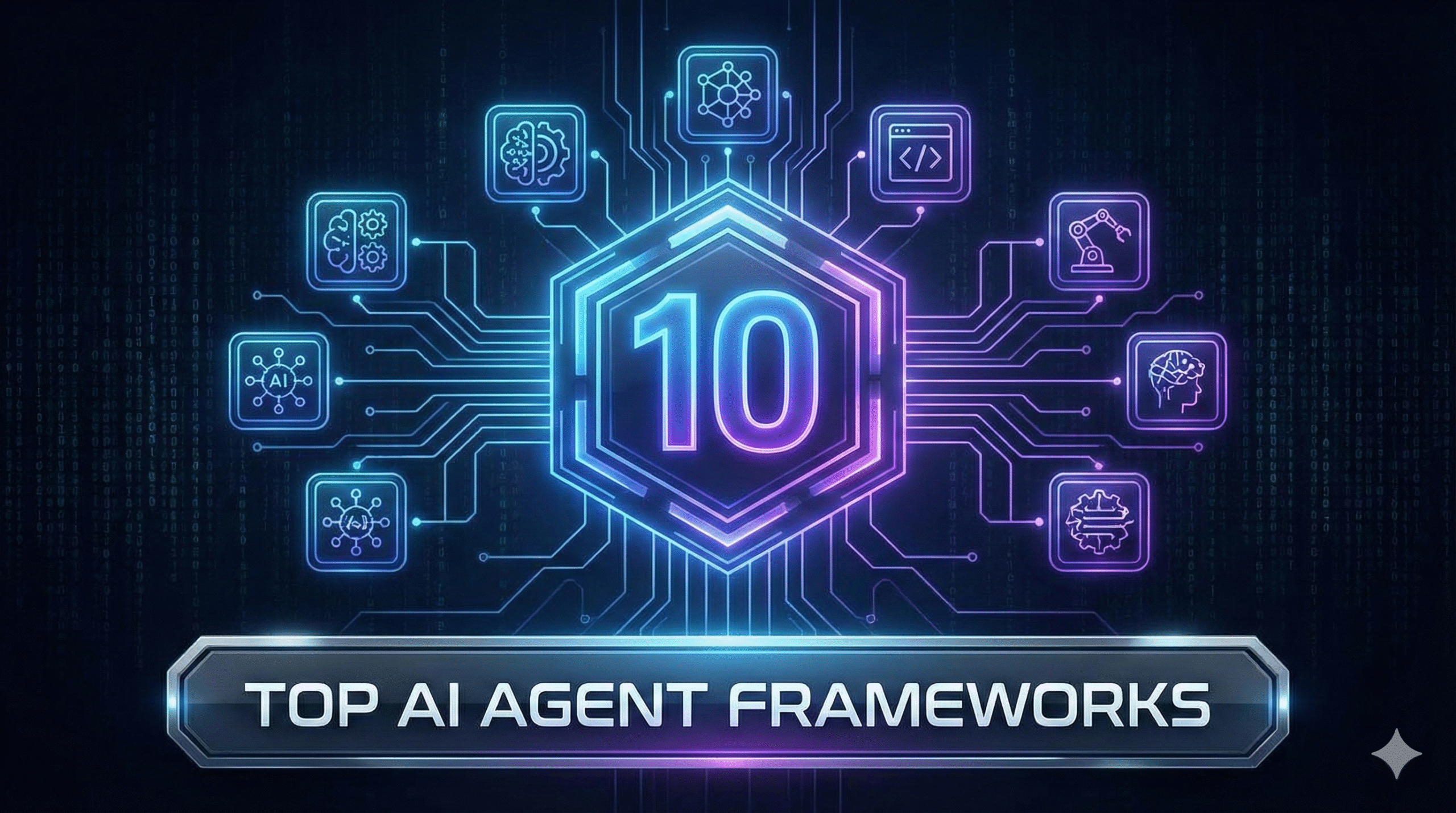
Top 10 AI Agent Frameworks Developers Should Learn
The artificial intelligence landscape is evolving at breakneck speed, and AI agent frameworks have become essential tools for developers building intelligent, autonomous systems. Whether you’re creating chatbots, automation tools, or complex multi-agent systems, choosing the right framework can dramatically accelerate your development process and improve your application’s capabilities.
This comprehensive guide examines the top 10 AI agent frameworks that every developer should consider learning in 2026. We’ll explore their unique features, use cases, strengths, and limitations to help you make informed decisions for your projects.
What Are AI Agent Frameworks?
AI agent frameworks are software libraries and tools that simplify the development of autonomous agents—programs that can perceive their environment, make decisions, and take actions to achieve specific goals. These frameworks abstract away much of the complexity involved in working with large language models (LLMs), managing state, handling tool integration, and orchestrating multi-step workflows.
According to research from Microsoft Research, effective agent frameworks typically provide capabilities for memory management, tool use, planning, and collaboration between multiple agents.
Key Benefits: AI agent frameworks reduce development time by 60-80%, provide battle-tested patterns for common challenges, and enable developers to focus on business logic rather than infrastructure.
The Top 10 AI Agent Frameworks
1LangChain
LangChain has established itself as the most popular and comprehensive framework for building LLM-powered applications and agents. Created by Harrison Chase, this Python and JavaScript framework provides extensive tools for chaining together language model calls, managing memory, and integrating external data sources.
Key Features:
- Chain Composition: Build complex workflows by chaining multiple components together
- Memory Systems: Multiple memory types including conversation buffers, summary memory, and vector stores
- Agent Types: ReAct, Plan-and-Execute, and custom agent architectures
- Tool Integration: Extensive library of pre-built tools and easy custom tool creation
- Document Loaders: Support for 100+ document types and data sources
✓ Pros
- Massive ecosystem and community
- Excellent documentation
- Regular updates and improvements
- Works with multiple LLM providers
✗ Cons
- Can be overwhelming for beginners
- Some abstractions add complexity
- Breaking changes in updates
Best For: Developers building production-grade applications with complex workflows, RAG (Retrieval-Augmented Generation) systems, and multi-agent orchestration. Learn more at LangChain Documentation.
2AutoGPT
AutoGPT pioneered the concept of autonomous AI agents that can break down complex tasks into subtasks and execute them independently. This open-source framework enables agents to self-direct, using iterative prompting to achieve user-defined goals without continuous human intervention.
Key Features:
- Autonomous Operation: Agents can plan and execute multi-step tasks independently
- Internet Access: Built-in web browsing and information gathering
- File Operations: Read, write, and manage files automatically
- Memory Management: Long-term and short-term memory for context retention
- Plugin System: Extensible architecture for custom capabilities
✓ Pros
- True autonomous operation
- Innovative self-improvement loops
- Active development community
- Great for research and experimentation
✗ Cons
- Can be unpredictable in production
- High API costs for complex tasks
- Requires careful monitoring
Best For: Experimental projects, research applications, and scenarios requiring high autonomy. Explore more at AutoGPT GitHub.
3CrewAI
CrewAI specializes in orchestrating collaborative AI agents that work together like a human team. Each agent has specific roles, goals, and tools, enabling sophisticated multi-agent workflows where agents delegate tasks and share information.
Key Features:
- Role-Based Agents: Define agents with specific expertise and responsibilities
- Task Delegation: Agents can assign subtasks to other specialized agents
- Process Flows: Sequential and hierarchical task execution patterns
- Built-in Tools: Web search, file operations, and custom tool integration
- Guardrails: Built-in safety mechanisms and validation
✓ Pros
- Intuitive multi-agent paradigm
- Clear role separation
- Excellent for complex workflows
- Good documentation and examples
✗ Cons
- Younger ecosystem than LangChain
- Limited third-party integrations
- Can be resource-intensive
Best For: Business process automation, content creation pipelines, and any scenario requiring multiple specialized agents working together. Visit CrewAI to learn more.
4LlamaIndex
Formerly known as GPT Index, LlamaIndex excels at creating data-aware AI applications. It’s specifically designed for building retrieval-augmented generation (RAG) systems that connect LLMs with your private data sources.
Key Features:
- Data Connectors: Ingest data from 100+ sources including APIs, databases, and documents
- Indexing Strategies: Multiple index types optimized for different use cases
- Query Engines: Advanced retrieval and ranking mechanisms
- Agent Tools: Convert indices into tools for agent workflows
- Evaluation Framework: Built-in tools for measuring RAG quality
✓ Pros
- Best-in-class RAG capabilities
- Optimized for production
- Excellent performance
- Strong enterprise adoption
✗ Cons
- Narrower focus than general frameworks
- Steeper learning curve for advanced features
- Resource requirements for large datasets
Best For: Building knowledge bases, customer support systems, and enterprise search applications. Check out LlamaIndex for comprehensive guides.
5Semantic Kernel (Microsoft)
Microsoft’s Semantic Kernel is an enterprise-grade SDK that integrates LLMs with conventional programming languages like C#, Python, and Java. It emphasizes production readiness, observability, and integration with Microsoft’s ecosystem.
Key Features:
- Multi-Language Support: Native SDKs for C#, Python, and Java
- Plugin System: Reusable skills and semantic functions
- Planning: Automatic plan generation and execution
- Memory Stores: Vector database integrations and semantic memory
- Azure Integration: Seamless integration with Azure AI services
✓ Pros
- Enterprise-grade reliability
- Excellent .NET integration
- Strong Microsoft support
- Production-ready features
✗ Cons
- Smaller community than LangChain
- Bias toward Azure ecosystem
- Documentation can lag behind features
Best For: Enterprise applications, .NET developers, and organizations heavily invested in Microsoft Azure. Learn more at Semantic Kernel Documentation.
6Haystack
Developed by deepset, Haystack is an end-to-end framework for building NLP applications powered by LLMs and transformer models. It excels at question answering, semantic search, and document retrieval systems.
Key Features:
- Pipeline Architecture: Modular components for flexible workflows
- Document Stores: Support for Elasticsearch, Weaviate, Pinecone, and more
- Retriever-Reader Pattern: Optimized for question answering
- Prompt Engineering: Built-in prompt templates and management
- Agent Capabilities: Tools and decision-making for autonomous agents
✓ Pros
- Excellent for search applications
- Production-tested at scale
- Strong open-source community
- Good evaluation tools
✗ Cons
- More focused on retrieval than agents
- Setup can be complex
- Less versatile than LangChain
Best For: Search engines, question-answering systems, and document intelligence applications. Visit Haystack for detailed tutorials.
7AutoGen (Microsoft)
AutoGen is Microsoft’s framework for building multi-agent conversational systems. It enables complex interactions between multiple autonomous agents and humans, making it ideal for collaborative problem-solving scenarios.
Key Features:
- Conversational Agents: Agents that communicate naturally with each other
- Human-in-the-Loop: Seamless integration of human feedback
- Code Execution: Agents can write and execute code safely
- Group Chat: Multiple agents collaborating in conversations
- Teaching Mode: Agents can learn from demonstrations
✓ Pros
- Innovative multi-agent conversations
- Excellent code generation capabilities
- Strong research backing
- Flexible agent configurations
✗ Cons
- Relatively new framework
- Smaller ecosystem
- Documentation still evolving
Best For: Research projects, educational tools, and applications requiring sophisticated agent collaboration. Explore AutoGen to get started.
8LangGraph
LangGraph, built by the LangChain team, extends LangChain with advanced capabilities for building stateful, graph-based agent workflows. It uses a graph structure to represent complex agent behaviors with multiple decision points.
Key Features:
- State Graphs: Model agent behavior as state machines
- Cycles and Branching: Support for loops and conditional logic
- Persistence: Built-in state persistence and checkpointing
- Human-in-the-Loop: Easy integration of approval steps
- Streaming: Real-time output streaming from long-running agents
✓ Pros
- Superior control over agent behavior
- Excellent for complex workflows
- Builds on LangChain ecosystem
- Great debugging capabilities
✗ Cons
- Requires LangChain knowledge
- More complex than simple chains
- Newer with fewer examples
Best For: Complex agent workflows with branching logic, multi-step approval processes, and stateful applications. Check the LangGraph Documentation.
9SuperAGI
SuperAGI is a developer-first framework for building, managing, and running autonomous AI agents. It provides a comprehensive toolkit with a focus on production deployment and monitoring.
Key Features:
- GUI Interface: Visual interface for agent creation and monitoring
- Tool Marketplace: Library of pre-built tools and integrations
- Multiple Agent Types: Support for various agent architectures
- Resource Management: Built-in token and cost tracking
- Agent Marketplace: Share and discover pre-configured agents
✓ Pros
- User-friendly interface
- Good for non-programmers
- Active development
- Cloud deployment options
✗ Cons
- Smaller community
- Less mature than top frameworks
- Limited customization in GUI
Best For: Teams wanting visual tools, rapid prototyping, and managed deployment options. Learn more at SuperAGI.
10AgentGPT
AgentGPT provides a browser-based platform for deploying autonomous AI agents. It emphasizes accessibility and ease of use, allowing users to create and deploy agents without extensive coding.
Key Features:
- Web-Based Interface: No local installation required
- Goal-Oriented Agents: Simply define objectives and let agents work
- Iteration Control: Manage how many steps agents take
- Result Tracking: Monitor agent progress and outputs
- API Integration: Connect to various external services
✓ Pros
- Extremely easy to get started
- No setup required
- Good for demonstrations
- Clean user interface
✗ Cons
- Limited customization
- Not suitable for production
- Fewer features than code-based frameworks
Best For: Experimentation, learning about autonomous agents, and quick demonstrations. Try it at AgentGPT.
Framework Comparison Overview
| Framework | Best Use Case | Difficulty Level | Production Ready |
|---|---|---|---|
| LangChain | General-purpose agent applications | Intermediate | ✓ Yes |
| AutoGPT | Autonomous research agents | Advanced | ⚠ Experimental |
| CrewAI | Multi-agent collaboration | Intermediate | ✓ Yes |
| LlamaIndex | RAG and data-aware apps | Intermediate | ✓ Yes |
| Semantic Kernel | Enterprise .NET applications | Intermediate | ✓ Yes |
| Haystack | Search and QA systems | Intermediate | ✓ Yes |
| AutoGen | Multi-agent conversations | Advanced | ⚠ Research-oriented |
| LangGraph | Complex stateful workflows | Advanced | ✓ Yes |
| SuperAGI | Managed agent deployment | Beginner | ⚠ Growing |
| AgentGPT | Quick prototyping | Beginner | ✗ No |
Choosing the Right Framework for Your Project
Selecting the appropriate AI agent framework depends on several factors. Here’s a decision framework to guide your choice:
Consider Your Use Case
Different frameworks excel at different tasks. If you’re building a RAG system with extensive document retrieval, LlamaIndex or Haystack should be your top choices. For multi-agent orchestration, CrewAI or AutoGen provide superior capabilities. General-purpose applications benefit most from LangChain’s versatility.
Evaluate Your Team’s Expertise
Your team’s programming language preferences and experience level matter significantly. .NET shops will find Semantic Kernel most natural, while Python developers have the widest framework selection. Beginners should start with SuperAGI or AgentGPT before progressing to more complex frameworks.
Production Requirements
Production deployments require frameworks with proven reliability, good observability, and active maintenance. LangChain, LlamaIndex, Semantic Kernel, and Haystack all meet these criteria. Experimental frameworks like AutoGPT are better suited for research and development environments.
Important Consideration: Many projects benefit from combining multiple frameworks. For example, using LlamaIndex for data retrieval within a LangChain agent workflow is a common and effective pattern.
Essential Features to Look For
When evaluating AI agent frameworks beyond this top 10 list, consider these critical features:
- LLM Provider Flexibility: Support for multiple providers (OpenAI, Anthropic, open-source models) prevents vendor lock-in
- Memory Management: Robust conversation history and context management capabilities
- Tool Integration: Easy integration with external APIs, databases, and services
- Observability: Logging, tracing, and debugging tools for production monitoring
- Streaming Support: Real-time output streaming for better user experience
- Error Handling: Graceful failure management and retry mechanisms
- Cost Management: Token usage tracking and optimization features
- Security: Built-in safeguards against prompt injection and other vulnerabilities
Getting Started: Learning Path Recommendations
Here’s a structured approach to learning AI agent frameworks effectively:
For Beginners
- Start with AgentGPT to understand agent concepts without coding
- Move to LangChain basics with simple chains and prompts
- Build a simple RAG application using LlamaIndex
- Experiment with CrewAI for multi-agent systems
For Intermediate Developers
- Master LangChain’s advanced features (agents, callbacks, custom tools)
- Explore LangGraph for stateful workflows
- Learn Haystack for production search systems
- Study AutoGen for multi-agent conversations
For Advanced Practitioners
- Implement custom agent architectures in LangChain
- Build complex multi-agent systems with CrewAI or AutoGen
- Optimize RAG pipelines with LlamaIndex advanced features
- Contribute to open-source frameworks and share learnings
Pro Tip: The best way to learn is by building. Start with a real project that interests you, even if small, and iterate based on what you learn. Join community forums and Discord servers for each framework you’re exploring.
Common Challenges and Solutions
Challenge 1: Framework Selection Paralysis
With so many options, choosing can be overwhelming. Solution: Start with the most popular framework for your primary use case. You can always switch or combine frameworks later as you better understand your needs.
Challenge 2: Managing API Costs
Agent applications can quickly become expensive. Solution: Implement token counting, caching strategies, and consider using smaller models for simpler tasks within your agent workflow.
Challenge 3: Debugging Agent Behavior
Autonomous agents can be unpredictable. Solution: Use frameworks with strong observability features. Enable verbose logging during development and implement step-by-step execution modes.
Challenge 4: Production Reliability
Agents may fail in unexpected ways. Solution: Implement comprehensive error handling, fallback strategies, and monitoring. Always include human-in-the-loop options for critical decisions.
“The future of software development is not about replacing programmers with AI agents, but about programmers orchestrating teams of specialized AI agents to accomplish complex tasks more efficiently than ever before.”
Future Trends in AI Agent Frameworks
The AI agent framework landscape is evolving rapidly. Here are key trends shaping the future:
Standardization Efforts
The industry is moving toward common standards for agent communication and tool integration. This will make it easier to combine agents built with different frameworks and share tools across ecosystems.
Enhanced Reasoning Capabilities
Frameworks are incorporating advanced reasoning techniques like chain-of-thought, self-reflection, and critique mechanisms that dramatically improve agent reliability and performance.
Better Cost Optimization
New frameworks are building in sophisticated caching, prompt compression, and intelligent model routing to reduce API costs while maintaining quality.
Visual Development Tools
Low-code and no-code interfaces for agent development are becoming more sophisticated, making AI agents accessible to non-programmers while still offering power users full control.
Ready to Build Your First AI Agent?
Start exploring these frameworks today! Check out our comprehensive tutorials and example projects to accelerate your learning journey. Join our community to share your experiences and learn from other developers.
Integration with Existing Systems
Most AI agent frameworks can integrate with existing applications through APIs, webhooks, or direct code integration. When planning your integration strategy:
- Start Small: Begin with a single use case or workflow rather than attempting a complete system overhaul
- API-First Design: Expose your agents through well-designed APIs for maximum flexibility
- Monitor Performance: Track response times, error rates, and user satisfaction from day one
- Plan for Scaling: Consider how your agent system will handle increased load as adoption grows
- Security First: Implement proper authentication, authorization, and input validation
Community and Resources
The AI agent development community is vibrant and helpful. Here are valuable resources for continued learning:
- Join framework-specific Discord servers and GitHub discussions
- Follow key researchers and developers on social media
- Participate in hackathons focused on AI agents
- Read academic papers on agent architectures and reasoning
- Attend conferences like AI Agents Summit
Don’t forget to explore our related content on prompt engineering best practices, AI memory systems, and LLM optimization techniques to deepen your expertise.
Conclusion
The AI agent framework ecosystem offers powerful tools for building intelligent, autonomous applications. Whether you choose LangChain’s comprehensive toolkit, CrewAI’s multi-agent orchestration, LlamaIndex’s data-aware capabilities, or any other framework on this list, you’re well-equipped to create sophisticated AI-powered solutions.
The key is to start experimenting, build real projects, and engage with the community. Each framework has its strengths, and the best choice depends on your specific needs, team expertise, and project requirements. Many successful applications combine multiple frameworks to leverage their respective strengths.
As AI agents become increasingly central to software development, mastering these frameworks will be a crucial skill for developers. The frameworks covered in this guide represent the cutting edge of AI agent development in 2026, but the field continues to evolve rapidly. Stay curious, keep learning, and don’t hesitate to contribute back to these open-source communities.
Next Steps: Choose one framework from this list, follow its official getting started guide, and build a simple agent within the next week. Learning by doing is the fastest path to mastery. Check our AI project ideas for inspiration!


No responses yet