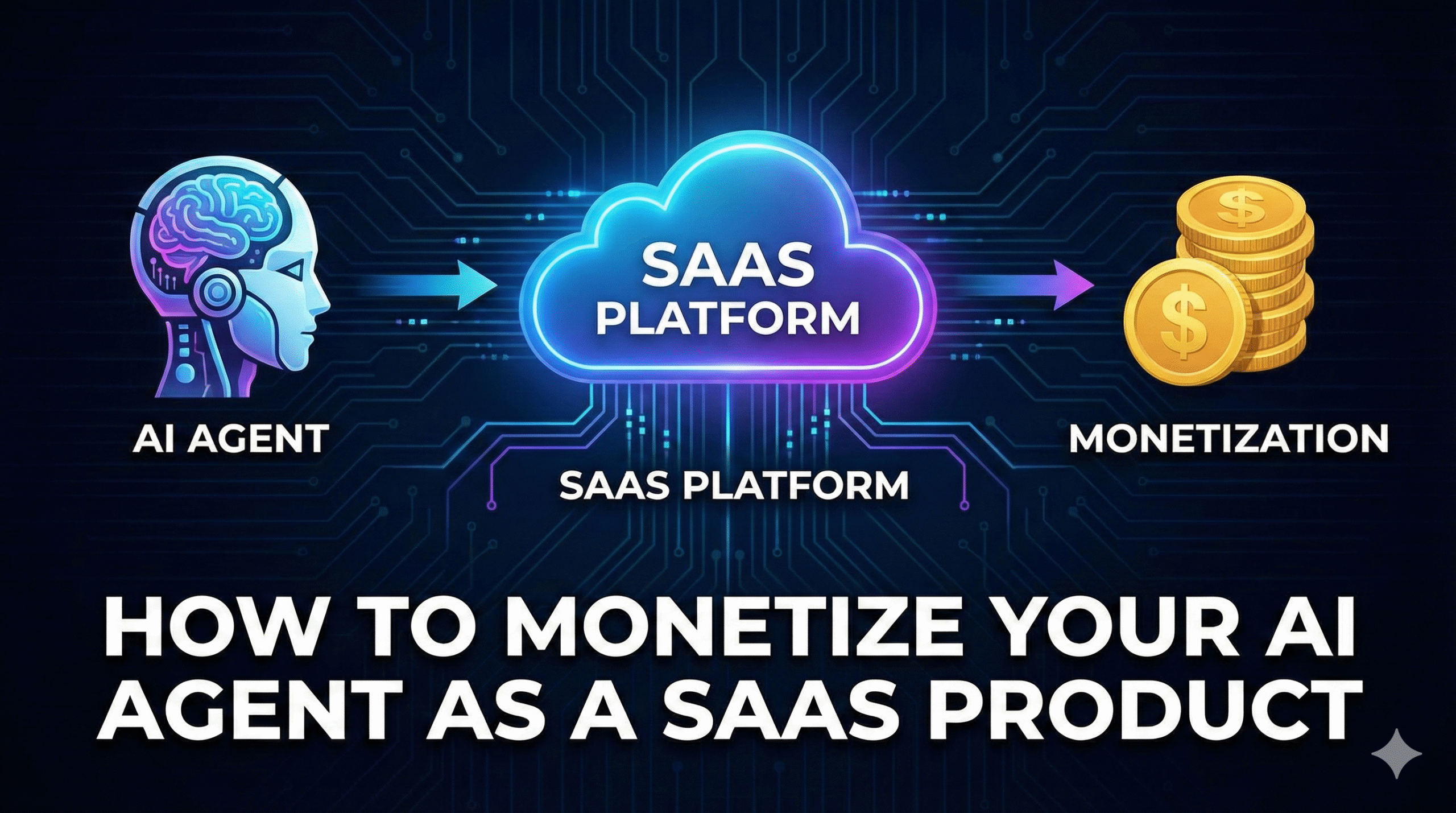
How to Monetize Your AI Agent as a SaaS Product
You’ve built an impressive AI agent that solves real problems. Now comes the crucial question: how do you turn this innovation into a sustainable, profitable business? The AI SaaS market is exploding, with global spending projected to reach $150 billion by 2027, but success requires more than just great technology—it demands smart monetization strategies.
This comprehensive guide will walk you through proven approaches to monetize your AI agent as a Software-as-a-Service (SaaS) product. From pricing models and business strategies to customer acquisition and scaling tactics, you’ll learn everything needed to transform your AI creation into revenue-generating business.
Understanding the AI SaaS Opportunity
Before diving into monetization strategies, it’s essential to grasp why AI agents represent such compelling SaaS opportunities. Unlike traditional software, AI agents offer several unique advantages that make them particularly suited for the subscription-based SaaS model.
AI agents continuously improve with usage, creating increasing value over time. They automate complex workflows that traditionally required human intelligence, justifying premium pricing. According to Gartner Research, companies using AI agents report 40% higher productivity compared to those using traditional software solutions.
Key Insight: The most successful AI SaaS products solve specific, high-value problems for well-defined customer segments rather than trying to be everything to everyone.
Choosing the Right Business Model
Your business model fundamentally shapes how you capture value from your AI agent. Let’s explore the most effective models for AI SaaS products in 2026.
Subscription-Based Model
The classic SaaS approach where customers pay recurring fees for ongoing access to your AI agent. This model provides predictable revenue and aligns incentives—your success depends on delivering continuous value.
Implementation Strategies:
- Tiered Pricing: Offer multiple subscription levels (Basic, Professional, Enterprise) with increasing features and usage limits
- Monthly vs Annual: Provide discounts for annual commitments (typically 15-20%) to improve cash flow and reduce churn
- User-Based: Price per seat, ideal when your AI agent serves multiple team members
- Usage-Based Tiers: Set monthly query/task limits for each tier with overage charges
Best For: AI agents with consistent, ongoing value delivery such as customer service bots, writing assistants, or data analysis tools. Companies like Jasper AI have built successful subscription businesses using this model.
Usage-Based Pricing (Consumption Model)
Customers pay based on actual usage—API calls, tokens processed, tasks completed, or data analyzed. This model scales naturally with customer value and is increasingly popular for AI products.
Key Advantages:
- Fair Pricing: Customers only pay for what they use, lowering entry barriers
- Natural Scaling: Revenue grows automatically as customers find more value
- Reduced Waste: Eliminates paying for unused capacity
- Predictable Costs: Customers can forecast expenses based on usage patterns
Challenge: Revenue unpredictability can make financial planning difficult. Consider hybrid models that combine base subscriptions with usage fees to stabilize revenue streams.
Best For: API-first AI products, developer tools, and scenarios where usage varies significantly between customers. Look at OpenAI’s pricing model as a successful example.
Freemium Model
Offer a free tier with limited capabilities, converting users to paid plans as they experience value and need more features or capacity. This model excels at customer acquisition but requires careful balance.
Success Factors:
- Generous Free Tier: Provide enough value to demonstrate your AI agent’s capabilities
- Clear Upgrade Path: Make premium benefits obvious and compelling
- Smart Limitations: Use features, usage caps, or advanced capabilities as upgrade drivers
- Conversion Optimization: Track free user behavior to identify upgrade opportunities
Best For: AI agents targeting individual users or small teams, products with viral potential, and markets where building awareness is critical. Companies like Grammarly demonstrate freemium success with AI writing tools.
Enterprise Licensing
Sell customized, high-touch solutions directly to large organizations with negotiated contracts, custom integrations, and dedicated support.
Enterprise Pricing Components:
- Base Platform Fee: Annual license for core AI agent capabilities
- Custom Development: One-time fees for specialized integrations or features
- Professional Services: Implementation, training, and ongoing consultation
- Support Packages: Premium SLAs with guaranteed response times
Best For: Sophisticated AI agents solving complex enterprise problems, products requiring integration with existing systems, or solutions handling sensitive data. Research from McKinsey shows enterprise AI contracts average $250K-$2M annually.
Crafting Your Pricing Strategy
Pricing is both art and science. Set prices too low and you’ll struggle to achieve profitability; too high and you’ll limit market penetration. Here’s how to find the sweet spot for your AI SaaS product.
Starter
- 1,000 AI queries/month
- Basic integrations
- Email support
- Standard features
Professional
- 10,000 AI queries/month
- Advanced integrations
- Priority support
- Advanced features
- Analytics dashboard
Enterprise
- Unlimited queries
- Custom integrations
- Dedicated support
- All features
- Custom AI training
- SLA guarantees
Value-Based Pricing Framework
The most effective pricing reflects the value your AI agent delivers to customers, not just your costs. Follow this framework:
- Quantify Customer Value: Calculate time saved, revenue generated, costs reduced, or productivity gained. If your AI agent saves a customer 20 hours per month, that’s worth thousands of dollars.
- Segment Your Market: Different customers derive different value. Small businesses might save $2,000 monthly while enterprises save $50,000. Price accordingly.
- Capture a Fair Share: Aim to capture 10-20% of the value you create. If you save a company $10,000 monthly, charging $1,000-$2,000 is justifiable.
- Consider Alternatives: Research what customers currently pay for alternative solutions, whether competing AI tools or manual processes.
Pro Tip: Run pricing experiments with small customer cohorts before finalizing. A/B test different price points and monitor conversion rates, customer lifetime value, and churn to optimize your pricing strategy.
Psychological Pricing Tactics
Smart pricing psychology can significantly impact conversion rates:
- Charm Pricing: Prices ending in 9 or 7 (e.g., $99 instead of $100) increase conversions by up to 20%
- Anchoring: Show your highest tier first to make other options seem more affordable
- Decoy Pricing: Include a middle tier designed to make your premium tier look attractive
- Annual Discounts: Offer 15-25% off annual plans to improve cash flow and reduce churn
Building Revenue Streams Beyond Subscriptions
Successful AI SaaS companies rarely rely on a single revenue source. Diversifying your monetization strategy increases stability and maximizes customer lifetime value.
API Access and White-Label Solutions
License your AI agent’s capabilities through APIs for developers to integrate into their own products. This B2B2C model can generate substantial additional revenue with minimal incremental cost.
- Charge per API call or set monthly quotas
- Offer white-label versions that partners can rebrand
- Provide premium support packages for integration partners
- Create revenue-sharing arrangements for resellers
Professional Services and Consulting
While pure SaaS scales better, professional services can significantly boost revenue, especially in early stages:
- Implementation Services: Help customers deploy and configure your AI agent ($5,000-$50,000+ per project)
- Custom Training: Fine-tune your AI agent on customer-specific data ($10,000-$100,000+)
- Strategic Consulting: Advise on AI strategy and workflow optimization ($200-$500+ per hour)
- Training Programs: Teach teams to maximize your AI agent’s value ($2,000-$10,000 per session)
Marketplace and Integrations
Create an ecosystem around your AI agent where third parties build add-ons, templates, or integrations:
- Take 20-30% commission on marketplace transactions
- Charge for premium listings or featured placements
- Offer certification programs for third-party developers
- Create paid integration partnerships with complementary tools
Case Study: Zapier’s Integration Marketplace
Zapier transformed from a simple automation tool into a platform by building an extensive integration marketplace. Today, over 6,000 app integrations drive significant portions of their $200M+ annual revenue. Your AI agent could follow a similar path by enabling third-party extensions and integrations.
Customer Acquisition Strategy
Even the best-monetized AI agent won’t succeed without customers. Here’s how to build an effective acquisition engine for your AI SaaS business.
Content Marketing and SEO
Position yourself as a thought leader while driving organic traffic. This long-term strategy builds compound returns:
- Educational Content: Create guides, tutorials, and use cases demonstrating your AI agent’s value
- SEO Optimization: Target high-intent keywords related to the problems you solve
- Case Studies: Showcase customer success stories with quantifiable results
- Technical Documentation: Comprehensive docs improve conversions and reduce support costs
Learn more about effective content marketing for AI products and SEO strategies for SaaS.
Product-Led Growth (PLG)
Let your AI agent sell itself through hands-on experience. This approach has powered companies like Slack, Dropbox, and Notion to billion-dollar valuations:
PLG Implementation Checklist:
- Offer immediate value without requiring sales conversations
- Design frictionless onboarding that demonstrates value in under 5 minutes
- Use in-app prompts to guide users toward “aha moments”
- Build viral loops where users invite colleagues or share results
- Implement usage-based triggers for upgrade prompts
- Create self-serve upgrade paths with transparent pricing
Strategic Partnerships
Leverage existing customer bases through partnerships:
- Technology Partners: Integrate with complementary platforms and cross-promote
- Reseller Networks: Enable agencies or consultants to resell your AI agent
- System Integrators: Partner with firms that implement enterprise software
- Industry Associations: Sponsor events and contribute to communities your customers belong to
Paid Advertising
While organic strategies build long-term value, paid ads accelerate growth when done right:
- Google Ads: Target high-intent search queries from people actively seeking solutions
- LinkedIn Ads: Excellent for B2B AI agents targeting specific industries or roles
- Retargeting: Re-engage website visitors who didn’t convert initially
- Content Promotion: Amplify your best content to reach larger audiences
“The best AI SaaS businesses don’t just sell software—they sell transformative outcomes. Focus on the problems you solve and the value you create, not on your technology’s features.” — Industry Research from Harvard Business Review
Optimizing Customer Retention and Expansion
Acquiring customers is expensive; retaining them is profitable. In AI SaaS, a 5% increase in retention can boost profits by 25-95% according to Harvard Business Review.
Reducing Churn
Churn is the silent killer of SaaS businesses. Combat it proactively:
- Onboarding Excellence: Customers who reach key milestones in the first week have 3x higher retention
- Regular Value Delivery: Send weekly or monthly reports showing the value your AI agent provides
- Proactive Support: Identify struggling customers early through usage analytics and reach out
- Feature Adoption: Customers using multiple features churn 50% less than single-feature users
- Community Building: Create user communities where customers share tips and best practices
Expansion Revenue
Your existing customers represent your best growth opportunity. Focus on increasing their spending over time:
| Expansion Strategy | Implementation | Expected Impact |
|---|---|---|
| Usage-Based Upgrades | Automatic tier increases as usage grows | 20-30% revenue lift |
| Feature Upsells | Premium features available as add-ons | 15-25% revenue lift |
| Seat Expansion | Add more team members to account | 30-50% revenue lift |
| Annual Conversions | Monthly to annual plan upgrades | Improved cash flow |
| Cross-Sells | Additional AI agents or related products | 25-40% revenue lift |
Scaling Your AI SaaS Business
As your customer base grows, your infrastructure, costs, and operations must scale efficiently. Here’s how to prepare for growth:
Infrastructure and Cost Management
AI agents can be expensive to operate due to API costs and compute requirements:
- Model Optimization: Use smaller, faster models for simpler tasks and reserve powerful models for complex queries
- Caching Strategies: Cache common responses to reduce API calls by 30-50%
- Batch Processing: Process non-urgent requests in batches during off-peak hours
- Cost Monitoring: Track per-customer costs and ensure pricing covers expenses with healthy margins
- Volume Discounts: Negotiate better rates with LLM providers as your usage scales
Critical Consideration: Unit economics matter from day one. If your cost to serve a customer exceeds what they pay, you’re building an unsustainable business. Aim for gross margins above 70% for healthy SaaS economics.
Team Building
Scale your team strategically as revenue grows:
- Early Stage (0-$1M ARR): Focus on product development and initial customer success
- Growth Stage ($1M-$10M ARR): Invest in sales, marketing, and customer support
- Scale Stage ($10M+ ARR): Build specialized teams for engineering, product, sales, and operations
International Expansion
AI SaaS products often have global appeal. Consider these factors when expanding internationally:
- Language Support: Localize your AI agent for major markets (Spanish, French, German, Japanese, Mandarin)
- Data Compliance: Ensure compliance with GDPR, CCPA, and other regional data protection laws
- Payment Processing: Support local payment methods beyond credit cards
- Pricing Localization: Adjust pricing for purchasing power in different markets
- Local Partnerships: Work with regional partners who understand local markets
Ready to Launch Your AI SaaS Business?
Transform your AI agent into a profitable SaaS product using the strategies in this guide. Start with a clear business model, test your pricing, and focus relentlessly on customer value.
Get Started TodayLegal and Compliance Considerations
AI SaaS businesses face unique legal challenges. Address these proactively to avoid costly problems later:
Data Privacy and Security
- Data Protection: Implement encryption, access controls, and regular security audits
- Privacy Policies: Clearly communicate how you collect, use, and protect customer data
- Compliance Certifications: Obtain SOC 2, ISO 27001, or other relevant certifications for enterprise sales
- Data Residency: Offer options for data storage in specific geographic regions
Terms of Service and Liability
Protect your business with clear terms that address AI-specific concerns:
- Define acceptable use policies for your AI agent
- Disclaim liability for AI-generated content or recommendations
- Specify service level agreements (SLAs) and remedies for downtime
- Address intellectual property rights for AI outputs
Consult with legal experts specializing in AI and SaaS. Resources like TermsFeed provide templates, but professional legal review is essential.
Measuring Success: Key Metrics to Track
What gets measured gets managed. Track these essential metrics to optimize your AI SaaS business:
Revenue Metrics
- Monthly Recurring Revenue (MRR): Total predictable monthly revenue from subscriptions
- Annual Recurring Revenue (ARR): MRR multiplied by 12, your baseline revenue projection
- Average Revenue Per User (ARPU): Total revenue divided by total customers
- Customer Lifetime Value (LTV): Average revenue generated per customer over their lifetime
Growth Metrics
- Customer Acquisition Cost (CAC): Total sales and marketing expenses divided by new customers
- LTV:CAC Ratio: Aim for 3:1 or higher for sustainable growth
- Net Revenue Retention (NRR): Revenue retention including expansions and upsells (target 110%+)
- Churn Rate: Percentage of customers canceling monthly (aim for under 5%)
Product Metrics
- Daily/Monthly Active Users: How many users engage regularly with your AI agent
- Feature Adoption: Which features drive retention and upgrades
- Time to Value: How quickly new users experience their first success
- Net Promoter Score (NPS): Customer satisfaction and likelihood to recommend
Explore our comprehensive guide on building a SaaS metrics dashboard to track these KPIs effectively.
Common Pitfalls to Avoid
Learn from others’ mistakes to accelerate your success:
Pitfall 1: Underpricing Your AI Agent
Many founders price too low, fearing customer resistance. This limits resources for growth and attracts price-sensitive customers who churn easily. Solution: Price based on value delivered, not costs incurred. You can always lower prices but raising them is difficult.
Pitfall 2: Neglecting Customer Success
Acquiring customers without ensuring they succeed leads to high churn. Solution: Invest in onboarding, documentation, and proactive support from day one. Customer success isn’t a cost center—it’s a retention and expansion engine.
Pitfall 3: Feature Bloat
Adding features without strategy dilutes your product and confuses users. Solution: Maintain a clear product vision. Every feature should serve your core value proposition. Master saying “no” to feature requests that don’t align.
Pitfall 4: Ignoring Unit Economics
Growing rapidly while losing money on each customer creates an unsustainable business. Solution: Understand your costs per customer and ensure pricing provides healthy margins. Optimize infrastructure costs as you scale.
Future-Proofing Your AI SaaS Business
The AI landscape evolves rapidly. Build adaptability into your business:
- Model Agnostic Architecture: Design your system to work with multiple LLM providers, avoiding vendor lock-in
- Continuous Learning: Stay updated on AI advancements and incorporate improvements regularly
- Customer Feedback Loops: Build systematic processes for gathering and acting on customer input
- Competitive Monitoring: Track competitor offerings and market trends to stay ahead
- Innovation Pipeline: Dedicate resources to researching emerging AI capabilities
Conclusion
Monetizing an AI agent as a SaaS product requires more than technical expertise—it demands strategic thinking about business models, pricing, customer acquisition, and retention. The most successful AI SaaS companies combine innovative technology with proven business fundamentals.
Start by choosing a business model that aligns with your target market and value proposition. Implement value-based pricing that captures a fair share of the benefits you deliver. Focus intensely on customer acquisition through content marketing, product-led growth, and strategic partnerships. Then optimize relentlessly for retention and expansion revenue.
Remember that building a sustainable AI SaaS business is a marathon, not a sprint. Focus on solving real problems for specific customer segments, deliver consistent value, and maintain unit economics that support profitable growth. The AI SaaS opportunity is enormous, and with the right monetization strategy, your AI agent can become a thriving, valuable business.
Next Steps: Define your business model, validate your pricing with potential customers, and launch a minimum viable product (MVP) within 90 days. Iterate based on real customer feedback rather than assumptions. For more resources, check our guides on building AI MVPs, SaaS marketing strategies, and customer success for AI products.
No responses yet