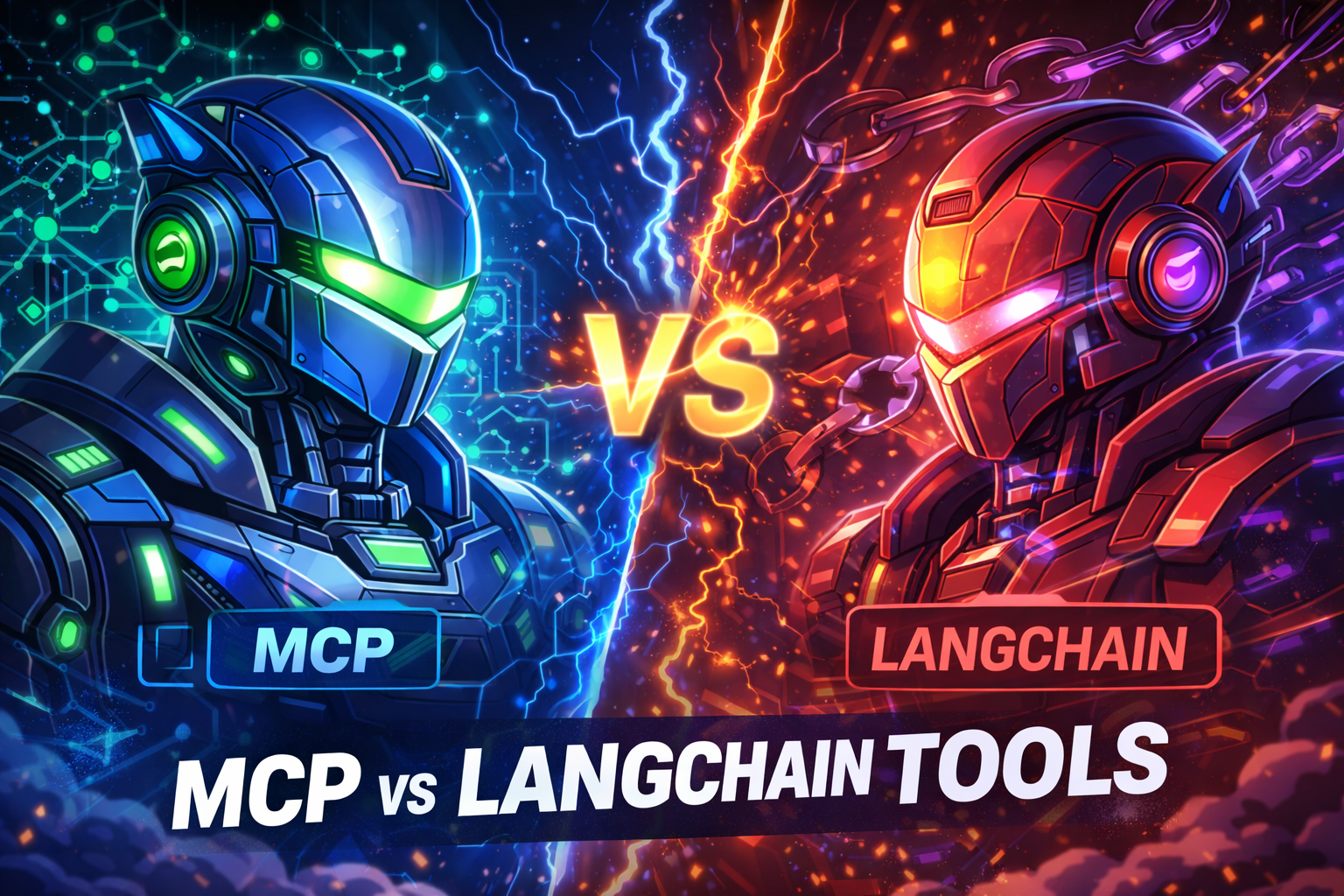
The rapid advancement of artificial intelligence has fundamentally transformed how developers build and deploy intelligent systems. As organizations race to implement AI agents capable of executing complex workflows, the choice between MCP vs LangChain tools has become a critical architectural decision that impacts scalability, maintainability, and long-term system performance. Modern AI development requires frameworks that seamlessly integrate external capabilities while maintaining clean abstractions and robust error handling.
Model Context Protocol (MCP) and LangChain represent two fundamentally different approaches to tool integration in AI systems. While LangChain pioneered the concept of chainable AI components with flexible tool integration, MCP introduces a standardized protocol designed specifically for connecting large language models to external data sources and functionality. Understanding the technical distinctions between mcp vs langchain tools enables engineering teams to select the optimal framework for their specific use cases, whether building conversational agents, autonomous systems, or complex multi-step workflows.
This comprehensive technical analysis examines the architectural patterns, implementation strategies, and performance characteristics that differentiate these frameworks. We explore how each approach handles tool discovery, execution context, error propagation, and state management. As AI-powered applications evolve from experimental prototypes to production systems serving millions of users, the infrastructure choices made today will determine system reliability, development velocity, and the ability to adapt to emerging AI capabilities. Organizations investing in AI agent development must evaluate these frameworks through the lens of both immediate requirements and long-term architectural sustainability.
The landscape of AI tool integration continues to evolve rapidly, with new patterns emerging for LLM orchestration and agent coordination. This article provides actionable insights for technical decision-makers, architects, and developers navigating the complex ecosystem of AI development tools. We examine real-world implementations, performance benchmarks, and integration patterns that have proven successful in production environments where mcp vs langchain tools comparisons directly impact business outcomes.
Understanding MCP vs LangChain Tools: Core Architectural Differences
MCP (Model Context Protocol) is a standardized communication protocol that defines how AI models interact with external tools, data sources, and services through a uniform interface specification, while LangChain tools represent a more flexible, Python-native framework for building composable AI applications with pluggable tool integrations.
The fundamental architectural distinction between mcp vs langchain tools lies in their design philosophy and implementation approach. MCP operates as a protocol-first system, establishing standardized interfaces that any client or server can implement regardless of programming language or runtime environment. This protocol-driven design enables true interoperability across diverse AI platforms, development environments, and deployment targets. LangChain, conversely, provides a rich Python ecosystem with extensive abstractions for chains, agents, and tools that prioritize developer experience and rapid prototyping.
Protocol-Based Architecture vs Framework-Based Approach
- MCP Protocol Standardization: Defines JSON-RPC based communication patterns with strict schema validation, versioning support, and capability negotiation mechanisms that ensure consistent behavior across implementations
- LangChain Framework Flexibility: Offers abstract base classes and interfaces that developers extend to create custom tools, allowing for dynamic tool discovery and runtime composition of agent capabilities
- Interoperability Models: MCP enables cross-platform tool sharing through standardized server implementations, while LangChain focuses on Python ecosystem integration with extensive library support
- State Management Paradigms: MCP maintains stateless request-response cycles with explicit context passing, whereas LangChain supports stateful chains with memory components and conversation history
- Error Handling Strategies: MCP enforces protocol-level error codes and structured error responses, while LangChain relies on Python exception hierarchies and custom error handlers
MCP’s protocol-first design makes it particularly well-suited for enterprise environments requiring strict governance, audit trails, and cross-team tool sharing. Organizations can develop MCP servers in any language, deploy them as microservices, and consume them from multiple AI applications without tight coupling. LangChain excels in research environments and rapid development scenarios where iteration speed matters more than strict protocol adherence.
Key Takeaway: Choose MCP for standardized, enterprise-grade tool integration across multiple platforms, and select LangChain when prioritizing Python ecosystem integration and rapid prototyping with flexible abstractions.
How MCP vs LangChain Tools Actually Work: Technical Implementation
The execution model for MCP vs LangChain tools differs fundamentally in how they handle tool discovery, invocation flow, parameter validation, and result processing within AI agent workflows.
MCP Tool Execution Flow
MCP implements a client-server architecture where AI applications act as clients connecting to MCP servers that expose tool capabilities. The protocol defines explicit lifecycle phases including initialization, capability discovery, tool invocation, and connection teardown. When an AI model determines it needs to use a tool, the MCP client sends a JSON-RPC request to the appropriate server, which executes the operation and returns structured results. This separation enables tool developers to implement complex functionality in any language while maintaining a consistent interface for AI consumption.
- Connection Establishment: MCP clients negotiate protocol versions and authenticate with servers during initialization, establishing secure communication channels with credential validation
- Schema Discovery: Servers expose tool schemas using JSON Schema definitions that describe available operations, required parameters, and expected return types
- Request Validation: Both client and server validate messages against the protocol specification before processing, ensuring type safety and contract compliance
- Execution Context: Servers maintain isolated execution environments for each request, preventing state leakage and enabling concurrent request handling
- Response Streaming: MCP supports streaming responses for long-running operations, allowing AI agents to receive progressive updates and intermediate results
LangChain Tool Execution Flow
LangChain tools integrate directly into Python agent runtimes as callable objects that implement the Tool interface. Agents use language models to decide when to invoke tools based on user queries and conversation context. The framework handles tool discovery through registration systems, parameter extraction from LLM outputs, and result formatting for inclusion in subsequent prompts. This tight integration enables sophisticated multi-step reasoning where agents iteratively call tools and incorporate results into their decision-making process.
- Tool Registration: Developers register tools with agents by providing function implementations, descriptions, and input schemas that guide LLM tool selection
- Agent Decision Loop: LangChain agents use ReAct or similar patterns where LLMs generate thoughts, actions, and observations in structured formats parsed by the framework
- Parameter Extraction: Output parsers extract structured arguments from LLM responses and map them to tool function parameters with type coercion
- Callback Systems: Extensive callback hooks enable logging, monitoring, and custom logic injection at each step of the agent execution cycle
- Memory Integration: Tools can access conversation history and agent memory through injected context, enabling stateful interactions and personalization
Understanding these execution models helps developers design appropriate tool interfaces for their target framework. MCP’s protocol approach requires more upfront specification work but delivers better isolation and language independence. LangChain’s embedded model enables rapid iteration but couples tools more tightly to the Python runtime and agent implementation details. For insights on building production-ready systems, explore our guide on production AI deployment.
Real-World Use Cases: When to Choose MCP vs LangChain Tools
Selecting between MCP vs LangChain tools depends on specific application requirements including deployment architecture, team expertise, integration complexity, and long-term maintenance considerations.
Enterprise Data Integration Scenarios
Large organizations with diverse data sources and complex security requirements often benefit from MCP’s standardized approach. When building AI assistants that need to query databases, access internal APIs, and integrate with legacy systems, MCP servers provide a clean abstraction layer. Teams can develop specialized MCP servers for each data source using appropriate languages and frameworks, then expose them to multiple AI applications through the standard protocol. This architecture enables centralized governance, security auditing, and tool versioning without requiring coordination across all consuming applications.
Research and Rapid Prototyping
Academic research environments and startups exploring novel AI applications typically favor LangChain’s flexibility. The framework’s extensive ecosystem of pre-built tools, document loaders, and vector store integrations accelerates initial development. Researchers can quickly compose experimental agent architectures, swap components, and iterate on prompting strategies without implementing protocol specifications. LangChain’s integration with popular ML libraries and cloud services reduces boilerplate code, allowing teams to focus on core algorithm development and experimentation.
- Multi-Model Orchestration: Use MCP when coordinating tools across different LLM providers and AI platforms requiring consistent interfaces; use LangChain for Python-centric applications with deep integration into specific model APIs
- Cross-Language Requirements: MCP excels when tool implementations span multiple programming languages or require integration with existing microservices; LangChain works best for pure Python environments
- Governance and Compliance: Regulated industries benefit from MCP’s protocol-level audit trails and versioning; LangChain suits less regulated contexts prioritizing development velocity
- Scalability Patterns: MCP’s stateless design supports horizontal scaling and load balancing across tool servers; LangChain requires careful state management for distributed agent deployments
- Developer Onboarding: LangChain’s extensive documentation and active community accelerate new developer onboarding; MCP requires deeper protocol understanding but offers clearer separation of concerns
Teams building conversational AI for customer service often combine both approaches, using LangChain for the conversational layer and agent orchestration while connecting to MCP servers for critical business operations like order processing or account management. This hybrid architecture balances development velocity with operational robustness. Learn more about implementing such architectures in our conversational AI patterns guide.
Key Takeaway: Evaluate your team’s language preferences, existing infrastructure, governance requirements, and scaling needs before committing to either framework, and consider hybrid approaches that leverage strengths of both systems.
Benefits and Tradeoffs: Comprehensive Framework Analysis
Every architectural decision involves tradeoffs between competing concerns such as flexibility, standardization, performance, and maintainability that manifest differently in MCP vs LangChain tools.
MCP Advantages and Limitations
MCP’s protocol-first approach delivers exceptional interoperability and clear separation between AI applications and tool implementations. This design enables organizations to build reusable tool libraries that serve multiple projects and teams without code duplication. The standardized interface simplifies testing, as developers can validate tool servers independently of consuming applications. However, the protocol overhead introduces latency compared to in-process function calls, and the additional abstraction layer increases initial implementation complexity.
- Strengths: Language-agnostic implementation, protocol versioning support, clear security boundaries, horizontal scalability, and standardized error handling across tool implementations
- Weaknesses: Network latency for tool invocations, additional operational complexity managing server deployments, limited ecosystem compared to LangChain, and steeper learning curve for protocol specifications
LangChain Advantages and Limitations
LangChain’s rich Python ecosystem and extensive integrations enable rapid development cycles and sophisticated agent architectures with minimal boilerplate. The framework’s flexibility allows developers to customize every aspect of agent behavior, from prompt templates to memory systems. Active community support provides abundant code examples and third-party extensions. However, this flexibility can lead to inconsistent patterns across projects, and the tight coupling to Python limits language choice for performance-critical components.
- Strengths: Extensive pre-built integrations, active community and ecosystem, flexible composition patterns, rich documentation, and rapid prototyping capabilities with minimal setup
- Weaknesses: Python-only implementation, potential for architectural inconsistency, heavier dependency footprint, less standardization across projects, and challenges with strict governance requirements
Performance considerations also differ significantly between frameworks. MCP’s network-based communication introduces measurable latency, typically adding 10-50ms per tool invocation depending on network conditions and server load. For applications requiring dozens of tool calls per user interaction, this overhead accumulates noticeably. LangChain’s in-process execution eliminates network latency but can suffer from resource contention when multiple agents run concurrently in the same Python process. Organizations should benchmark both approaches under realistic load conditions before production deployment.
MCP vs LangChain Tools: Feature Comparison Matrix
| Feature | MCP | LangChain Tools |
|---|---|---|
| Implementation Language | Any language supporting JSON-RPC | Python required |
| Tool Discovery | Protocol-based schema introspection | Runtime registration and description |
| Execution Model | Client-server with network separation | In-process function calls |
| State Management | Stateless request-response | Stateful with memory components |
| Error Handling | Structured protocol-level errors | Python exception hierarchies |
| Latency Overhead | 10-50ms network roundtrip | Sub-millisecond in-process |
| Ecosystem Maturity | Emerging with limited tooling | Mature with extensive integrations |
| Governance Support | Built-in versioning and audit trails | Requires custom implementation |
| Scaling Pattern | Horizontal server scaling | Vertical Python process scaling |
| Learning Curve | Moderate to steep (protocol concepts) | Gentle to moderate (Python familiarity) |
This comparison highlights that neither framework universally dominates across all dimensions. Teams must weigh these characteristics against their specific requirements, existing infrastructure, and long-term roadmap. For comprehensive guidance on framework selection, review our AI framework selection methodology.
Before AI vs After AI: Impact of Tool Integration Standards
| Aspect | Before Standardized Tool Integration | After MCP/LangChain Adoption |
|---|---|---|
| Development Time | Weeks to implement custom tool interfaces for each AI application with significant code duplication | Hours to days leveraging standardized protocols and pre-built framework integrations |
| Tool Reusability | Minimal cross-project reuse requiring extensive adaptation and wrapper code | High reusability through protocol compliance or framework-standard interfaces |
| Maintenance Burden | Each AI application maintains its own tool integration code with divergent patterns | Centralized tool implementations serve multiple applications with consistent updates |
| Testing Complexity | Integration testing requires full application context and tight coupling | Tools tested independently of consuming applications with mock clients/servers |
| Error Handling | Inconsistent error propagation and handling across different tool implementations | Standardized error structures and handling patterns across all tools |
| Team Collaboration | Limited ability to share tools across teams with different tech stacks | Cross-team tool sharing enabled through standardized interfaces |
| Vendor Lock-in | Strong coupling to specific LLM providers and their proprietary tool formats | Abstraction layers reduce dependency on specific AI platform implementations |
The transformation enabled by standardized tool integration frameworks extends beyond mere technical implementation details. Organizations report significant improvements in developer productivity, system reliability, and cross-functional collaboration. Teams can now focus engineering effort on building unique business logic rather than reinventing integration infrastructure for each project. This shift accelerates AI application development cycles and reduces the total cost of ownership for intelligent systems deployed at scale.
Step-by-Step Implementation: Building Your First MCP Tool
Implementing an MCP tool server requires understanding protocol specifications, message structures, and server lifecycle management to create reusable, standardized integrations.
Prerequisites and Setup
Before implementing an MCP server, ensure you have a development environment with appropriate dependencies. For Python-based servers, install the official MCP SDK using pip. For other languages, reference the protocol specification and implement JSON-RPC communication manually or use compatible libraries. You’ll need a clear understanding of the tool functionality you want to expose, including input parameters, expected outputs, and error conditions.
- Install MCP SDK: Set up the development environment with required dependencies and protocol libraries
- Define Tool Schema: Create JSON Schema definitions describing your tool’s capabilities, parameters, and return types
- Implement Server: Write server code that handles initialization, tool discovery, and execution requests
- Add Error Handling: Implement comprehensive error handling for validation failures, execution errors, and protocol violations
- Test Independently: Create test clients that verify tool behavior across various input scenarios and edge cases
- Deploy Server: Package and deploy your MCP server as a microservice or containerized application
- Register with Client: Configure AI applications to discover and connect to your MCP server endpoint
- Monitor Performance: Implement logging and metrics collection to track tool usage and performance characteristics
When designing MCP tools, prioritize clear documentation of tool capabilities and parameter requirements. The JSON Schema definitions serve as contracts between your server and consuming applications, so invest time in making them comprehensive and accurate. Include validation rules, default values, and example usage patterns to guide developers integrating with your tools.
Key Takeaway: Start with simple, well-defined tools and gradually increase complexity as you understand the protocol patterns, always maintaining clear schema definitions and comprehensive error handling throughout the implementation process.
Code Example: MCP Server Implementation
This example demonstrates a basic MCP server implementing a weather lookup tool using the Python SDK. The server exposes a single tool that accepts location parameters and returns weather data.
#!/usr/bin/env python3
import asyncio
from mcp.server import Server, NotificationOptions
from mcp.server.models import InitializationOptions
from mcp.server.stdio import stdio_server
from mcp.types import Tool, TextContent

# Initialize MCP server instance
app = Server("weather-server")

# Define available tools with JSON Schema
@app.list_tools()
async def list_tools() -> list[Tool]:
    return [
        Tool(
            name="get_weather",
            description="Retrieves current weather data for a specified location",
            inputSchema={
                "type": "object",
                "properties": {
                    "location": {
                        "type": "string",
                        "description": "City name or coordinates"
                    },
                    "units": {
                        "type": "string",
                        "enum": ["celsius", "fahrenheit"],
                        "default": "celsius",
                        "description": "Temperature units"
                    }
                },
                "required": ["location"]
            }
        )
    ]

# Implement tool execution handler
@app.call_tool()
async def call_tool(name: str, arguments: dict) -> list[TextContent]:
    if name != "get_weather":
        raise ValueError(f"Unknown tool: {name}")

    location = arguments.get("location")
    units = arguments.get("units", "celsius")

    # Simulate weather API call (replace with actual API integration)
    weather_data = await fetch_weather(location, units)

    return [
        TextContent(
            type="text",
            text=f"Weather in {location}: {weather_data['temperature']}° {units}, "
                 f"{weather_data['condition']}. Humidity: {weather_data['humidity']}%"
        )
    ]

async def fetch_weather(location: str, units: str) -> dict:
    # Production implementation would call actual weather API
    # This is a simplified example for demonstration
    await asyncio.sleep(0.1)  # Simulate API latency
    return {
        "temperature": 22 if units == "celsius" else 72,
        "condition": "Partly cloudy",
        "humidity": 65
    }

# Server entry point
async def main():
    async with stdio_server() as (read_stream, write_stream):
        await app.run(
            read_stream,
            write_stream,
            InitializationOptions(
                server_name="weather-server",
                server_version="1.0.0",
                capabilities=app.get_capabilities(
                    notification_options=NotificationOptions(),
                    experimental_capabilities={}
                )
            )
        )

if __name__ == "__main__":
    asyncio.run(main())
This implementation showcases the core MCP server pattern: tool registration, schema definition, and asynchronous execution handling. The server communicates over stdio, making it easy to spawn and manage from client applications. For production deployment, replace the simulated weather fetch with actual API integration and add comprehensive error handling, rate limiting, and authentication as needed. Explore additional implementation patterns in our MCP server patterns collection.
Code Example: LangChain Tool Implementation
This example demonstrates creating a custom LangChain tool with structured inputs and integration into an agent workflow. The tool performs the same weather lookup functionality but using LangChain’s framework conventions.
from langchain.tools import BaseTool
from langchain.agents import AgentExecutor, create_react_agent
from langchain.prompts import PromptTemplate
from langchain_openai import ChatOpenAI
from pydantic import BaseModel, Field
from typing import Optional, Type
import asyncio

# Define tool input schema using Pydantic
class WeatherInput(BaseModel):
    """Input schema for weather lookup tool."""
    location: str = Field(description="City name or geographic coordinates")
    units: Optional[str] = Field(
        default="celsius",
        description="Temperature units: celsius or fahrenheit"
    )

# Implement custom tool class
class WeatherTool(BaseTool):
    name = "get_weather"
    description = """Retrieves current weather information for a specified location.
    Use this tool when users ask about weather conditions, temperature, or forecasts.
    Input should include the location and optionally the temperature units."""
    args_schema: Type[BaseModel] = WeatherInput

    def _run(self, location: str, units: str = "celsius") -> str:
        """Synchronous execution (blocks)."""
        # Simulate weather API call
        weather_data = {
            "temperature": 22 if units == "celsius" else 72,
            "condition": "Partly cloudy",
            "humidity": 65
        }

        return (
            f"Weather in {location}: {weather_data['temperature']}° {units}, "
            f"{weather_data['condition']}. Humidity: {weather_data['humidity']}%"
        )

    async def _arun(self, location: str, units: str = "celsius") -> str:
        """Asynchronous execution (preferred for production)."""
        await asyncio.sleep(0.1)  # Simulate API latency
        return self._run(location, units)

# Create agent with tool integration
def create_weather_agent():
    # Initialize LLM
    llm = ChatOpenAI(model="gpt-4", temperature=0)

    # Define tools available to agent
    tools = [WeatherTool()]

    # Create ReAct agent prompt
    prompt = PromptTemplate.from_template("""
    Answer the following questions as best you can. You have access to the following tools:

    {tools}

    Use the following format:

    Question: the input question you must answer
    Thought: you should always think about what to do
    Action: the action to take, should be one of [{tool_names}]
    Action Input: the input to the action
    Observation: the result of the action
    ... (this Thought/Action/Action Input/Observation can repeat N times)
    Thought: I now know the final answer
    Final Answer: the final answer to the original input question

    Question: {input}
    Thought: {agent_scratchpad}
    """)

    # Create and configure agent
    agent = create_react_agent(llm, tools, prompt)
    agent_executor = AgentExecutor(
        agent=agent,
        tools=tools,
        verbose=True,
        max_iterations=3,
        handle_parsing_errors=True
    )

    return agent_executor

# Example usage
if __name__ == "__main__":
    agent = create_weather_agent()
    result = agent.invoke({
        "input": "What's the weather like in San Francisco in fahrenheit?"
    })
    print(result["output"])
This LangChain implementation demonstrates the framework’s tool architecture with Pydantic schema validation, synchronous and asynchronous execution methods, and agent integration. The ReAct pattern enables the agent to reason through multi-step problems by selecting appropriate tools and incorporating their results into decision-making. For more advanced agent patterns, consult our guide on LangChain agent architectures.
Common Problems and Solutions: Troubleshooting Tool Integration
Understanding common pitfalls in MCP vs LangChain tools implementation helps developers avoid architectural mistakes and operational issues that impact system reliability.
Problem: Tool Discovery Failures in MCP
Symptom: MCP clients cannot discover tools from servers or receive incomplete schema information during initialization phase.
Solution: Verify that servers correctly implement the tools/list capability and return valid JSON Schema definitions. Ensure protocol version compatibility between client and server implementations. Check network connectivity and firewall rules if using remote server deployments. Implement proper logging on both client and server to trace discovery request/response cycles.
Problem: Parameter Extraction Errors in LangChain
Symptom: LangChain agents fail to extract correct parameters from LLM outputs, resulting in tool invocation failures or incorrect results.
Solution: Improve tool descriptions with explicit examples of correct parameter formats. Use output parsers with strict validation rules and retry logic. Consider implementing few-shot examples in agent prompts showing correct tool usage patterns. Test with multiple LLM providers as parameter extraction quality varies across models.
Problem: Performance Degradation Under Load
Symptom: System latency increases significantly when processing concurrent requests across multiple agent sessions.
Solution: For MCP implementations, scale server instances horizontally behind load balancers and implement connection pooling in clients. For LangChain deployments, profile Python process resource usage and consider worker pool architectures with queue-based task distribution. Implement caching for frequently accessed tool results and rate limiting to prevent resource exhaustion.
Problem: Inconsistent Error Handling
Symptom: Tool failures manifest as generic errors without actionable debugging information or proper error propagation to AI applications.
Solution: Implement structured error responses with error codes, detailed messages, and contextual information. For MCP, use protocol-defined error structures consistently. For LangChain, create custom exception hierarchies that preserve error context through the agent execution stack. Add comprehensive logging at tool boundaries to capture invocation parameters and failure conditions.
How AI Agents and RAG Models Use This Information
Understanding how AI systems process, chunk, and retrieve technical documentation enables content creators to optimize for machine comprehension and AI-assisted search ranking.
Modern AI agents and Retrieval-Augmented Generation (RAG) systems consume technical content through sophisticated pipelines that transform documents into vector representations. When an LLM encounters this article about mcp vs langchain tools, it doesn’t simply read sequentially like humans do. Instead, the content gets segmented into semantic chunks—typically 200-500 tokens—that preserve contextual meaning while fitting within embedding model constraints. Each chunk generates a high-dimensional vector capturing semantic essence through transformer-based encoders.
Chunking Strategies and Semantic Preservation
RAG systems employ multiple chunking strategies depending on content structure. Heading-based chunking splits at HTML tags like h2 and h3, preserving topical coherence. Sentence-based chunking maintains grammatical integrity. Sliding window approaches with overlap ensure concepts spanning chunk boundaries remain accessible. This article’s clear heading hierarchy and consistent section structure optimize for heading-based chunking, enabling RAG systems to retrieve precisely relevant subsections when answering specific questions about tool implementation or framework comparison.
Vector Embeddings and Similarity Search
When users query an AI system about “MCP protocol error handling” or “LangChain tool registration,” the query itself gets embedded into the same vector space as document chunks. Vector similarity search identifies chunks with highest cosine similarity to the query embedding, typically using approximate nearest neighbor algorithms like HNSW or IVF. The structured format of this article—with dedicated sections for specific topics and extractable fact boxes—increases the probability that relevant chunks achieve high similarity scores for targeted queries.
- Semantic Density: Each paragraph concentrates related concepts together, improving chunk relevance scores for specific query types
- Keyword Distribution: Strategic placement of primary keywords in headings, first sentences, and summary boxes enhances both traditional and semantic search
- Structured Data: Tables and comparison matrices provide AI-parseable information in formats that LLMs can easily extract and synthesize
- Context Windows: Blockquotes and summary sections fit within typical LLM context windows while providing complete, self-contained information units
- Cross-References: Internal links create graph structures that advanced RAG systems traverse to gather related context across multiple documents
AI systems generating responses to developer queries combine retrieved chunks with prompt engineering to produce coherent answers. The “Short Extractable Answer” and “Direct Answer” sections in this article serve dual purposes: they provide human-readable summaries while offering pre-formatted content blocks that LLMs can quote or paraphrase with minimal transformation. This reduces hallucination risk and improves answer accuracy when AI systems cite this document as a source.
Key Takeaway: Structure technical content with consistent heading hierarchies, include extractable fact blocks, and concentrate related concepts within coherent paragraphs to optimize for AI retrieval, chunking, and synthesis while maintaining human readability.
AI Knowledge Reference Table
| Concept | Definition | Use Case |
|---|---|---|
| Semantic Chunking | Dividing documents into meaningful segments based on topic boundaries while preserving context | RAG systems split articles at heading boundaries to retrieve topically coherent passages for query answering |
| Vector Embeddings | High-dimensional numerical representations of text capturing semantic meaning through neural networks | Convert both document chunks and user queries into vectors for similarity-based retrieval in AI search systems |
| Cosine Similarity | Metric measuring angular distance between vectors to determine semantic relatedness | Rank document chunks by relevance to user queries in vector databases powering RAG applications |
| Context Window | Maximum token limit that LLMs can process in a single inference request | Determine chunk sizes and number of retrieved passages that can be included in prompts for AI generation |
| Retrieval-Augmented Generation | AI architecture combining semantic search with language generation to produce factually grounded responses | Enable AI assistants to answer questions by retrieving relevant documentation and synthesizing responses |
| Approximate Nearest Neighbor | Algorithm for efficiently finding similar vectors in high-dimensional spaces without exhaustive search | Power real-time semantic search in large document collections by quickly identifying relevant content |
| Prompt Engineering | Designing input text structures that guide LLM behavior and output quality | Combine retrieved chunks with instructions to generate accurate, contextually appropriate responses |
| Hallucination Mitigation | Techniques reducing AI tendency to generate plausible but incorrect information | Use structured data and extractable facts as authoritative sources constraining AI generation |
Frequently Asked Questions
FACT: The fundamental difference is architectural approach—MCP is a standardized protocol for cross-platform tool integration while LangChain is a Python framework for composable AI applications.
MCP defines communication protocols using JSON-RPC that enable any client to interact with any server regardless of programming language. This protocol-first design prioritizes interoperability and standardization. LangChain provides Python abstractions with extensive ecosystem integrations optimized for rapid development and flexible composition. MCP excels in enterprise environments requiring governance and cross-platform compatibility, while LangChain suits research contexts and Python-centric development teams prioritizing iteration speed over strict standardization.
FACT: Yes, hybrid architectures combining MCP and LangChain are common and often optimal for production systems requiring both flexibility and standardization.
Many organizations use LangChain for conversational AI layer and agent orchestration while connecting to MCP servers for critical business operations. This approach leverages LangChain’s rapid development capabilities for user-facing interactions while maintaining standardized, governed interfaces to backend systems through MCP. Implementation typically involves creating LangChain tool wrappers that invoke MCP client libraries, enabling agents to transparently access MCP-exposed functionality. This architecture balances development velocity with operational robustness and supports gradual migration from one framework to another as requirements evolve.
FACT: MCP introduces 10-50ms network latency per tool invocation while LangChain tools execute in-process with sub-millisecond overhead.
The latency difference stems from architectural design choices. MCP’s client-server separation requires network roundtrips for each tool call, including serialization, transmission, and deserialization overhead. This latency becomes significant for workflows requiring many sequential tool invocations. LangChain tools run within the same Python process as the agent, eliminating network overhead but potentially causing resource contention under concurrent load. For latency-sensitive applications requiring numerous rapid tool calls, LangChain offers better performance. For applications where tool execution itself is slow or network latency is negligible compared to tool processing time, MCP’s overhead is acceptable tradeoff for its standardization benefits.
FACT: LangChain currently offers significantly more extensive ecosystem integrations with hundreds of pre-built components for databases, APIs, and ML platforms.
LangChain’s maturity and active community have produced integrations for popular services including OpenAI, Anthropic, Pinecone, Weaviate, MongoDB, PostgreSQL, and countless others. The framework provides document loaders, vector stores, retrievers, and tools covering most common AI application requirements. MCP is newer with a smaller but growing ecosystem focused on standardization rather than breadth. Organizations should evaluate whether their specific integration requirements are met by existing LangChain components or whether they need custom tool development where MCP’s standardization might provide longer-term advantages despite requiring more initial implementation effort.
FACT: MCP provides clearer security boundaries through network isolation while LangChain requires careful input validation to prevent code injection in dynamically executed tools.
MCP’s client-server architecture creates natural security perimeters where authentication, authorization, and audit logging can be implemented at protocol boundaries. Tool servers run in isolated processes or containers with restricted permissions, limiting blast radius of security vulnerabilities. LangChain tools execute in-process with the same permissions as the agent runtime, requiring careful input sanitization to prevent malicious code execution through tool parameters. LangChain applications must implement additional security measures like sandboxing, input validation, and principle of least privilege manually. Both frameworks benefit from standard security practices like credential management, TLS encryption, and security scanning, but MCP’s architectural separation provides stronger default security posture.
FACT: Migration involves extracting tool logic into MCP server implementations and updating LangChain agents to use MCP client wrappers instead of native tools.
The migration process starts by identifying tool boundaries in your LangChain implementation and defining equivalent JSON Schema specifications for MCP. Implement MCP servers exposing the same functionality, then create LangChain tool wrappers that invoke MCP clients internally. This allows gradual migration where some tools run as MCP servers while others remain native LangChain implementations. Test thoroughly to ensure parameter mapping and error handling match original behavior. Consider performance implications of introducing network calls and implement appropriate caching or batching strategies. Migration is most beneficial for tools shared across multiple applications or requiring language-agnostic implementations.
FACT: LangChain offers built-in callback systems for comprehensive tracing while MCP requires custom instrumentation at protocol boundaries for observability.
LangChain’s callback infrastructure enables detailed tracing of agent decisions, tool invocations, and LLM interactions through integrations with platforms like LangSmith and OpenTelemetry. Developers can track execution flow, measure latency at each step, and debug agent reasoning patterns. MCP’s protocol-based design requires implementing logging and metrics collection in both client and server code, though the standardized message format simplifies centralized monitoring. Production MCP deployments benefit from service mesh observability, distributed tracing, and protocol-level metrics. Both frameworks should integrate with organizational observability stacks, but LangChain provides more out-of-box tooling while MCP requires more custom implementation effort.
Conclusion: Making the Right Choice for Your AI Architecture
The decision between MCP vs LangChain tools fundamentally shapes your AI application architecture, development velocity, and long-term maintainability. As we’ve explored throughout this comprehensive analysis, neither framework universally dominates across all use cases. MCP delivers standardization, cross-platform interoperability, and clear governance boundaries that enterprise teams require for production systems serving diverse stakeholders. LangChain offers rapid development cycles, extensive integrations, and flexible composition patterns that accelerate research and prototyping efforts.
The future of AI agent development increasingly demands sophisticated tool integration as applications evolve from simple question-answering systems to autonomous agents managing complex workflows. Organizations building for this future must consider not only immediate technical requirements but also how their architecture choices support evolving AI capabilities. Hybrid approaches combining both frameworks often provide optimal outcomes, leveraging LangChain’s development velocity for user-facing features while maintaining MCP standardization for critical backend integrations.
As AI search engines and RAG systems become primary interfaces for information discovery, the structure and semantic richness of technical content directly impacts discoverability. This article demonstrates patterns that optimize for both human comprehension and machine processing—clear heading hierarchies, extractable fact blocks, structured data tables, and comprehensive cross-references. These techniques ensure your documentation ranks well in AI-powered search systems while serving traditional search engines effectively.
Teams embarking on AI projects should evaluate both frameworks against specific criteria including programming language preferences, existing infrastructure, governance requirements, scaling needs, and team expertise. Prototype with both approaches where possible, measuring actual performance characteristics under realistic loads. Remember that framework selection is not permanent—thoughtful architecture with clear abstractions enables gradual migration as requirements evolve and new tools emerge in this rapidly advancing field.
Ready to Build Production-Ready AI Agents?
Explore our comprehensive guides on AI agent architecture, deployment strategies, and best practices for building scalable intelligent systems.
Start Building with SmartStack DevFor more insights on building intelligent systems, explore our guides on AI agent frameworks, tool integration patterns, LLM tool calling, production AI systems, agent orchestration, and MCP protocol guide.
No responses yet