Pydantic AI vs Claude AI: Complete Comparison for Developers (2026 Guide)
Artificial Intelligence is transforming modern software development at a very fast speed. Today, developers are not only writing code manually but also using AI tools to build applications faster, smarter, and more efficiently.
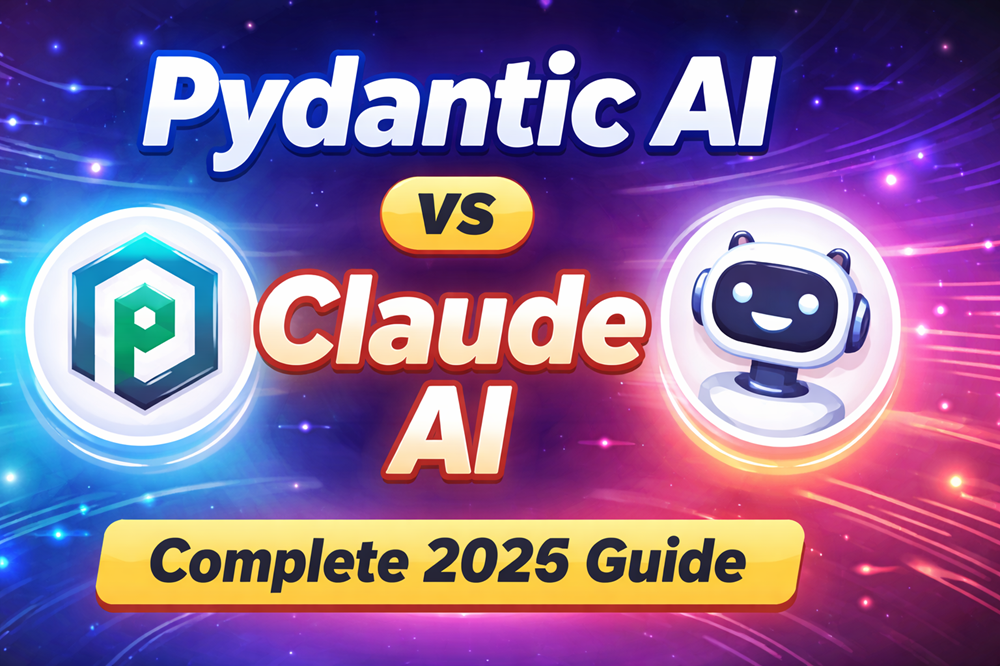
Among the most popular technologies in the AI ecosystem are Pydantic AI and Claude AI. Although both are related to AI, they are completely different in purpose.
Pydantic AI is a framework used to build structured AI applications, while Claude AI is a powerful large language model that generates intelligent responses, code, and natural language outputs.
In this blog, we will deeply compare both tools, understand their architecture, use cases, advantages, and help you decide which one is best for your needs in 2026.
2. What is Pydantic AI?
Pydantic AI is a Python-based framework designed to build reliable and structured AI systems. It is built on top of Pydantic, which is widely used for data validation.
It helps developers create AI agents that can interact with tools, APIs, and workflows in a structured way.
Key Features
- Strong data validation system
- Type-safe AI workflows
- Multi-model support (OpenAI, Claude, etc.)
- Backend integration support
- Production-ready architecture
It is mainly used in backend systems where structure and reliability are more important than just generating responses.
3. What is Claude AI?
Claude AI is a large language model developed by Anthropic. It is designed to understand and generate human-like text with high reasoning ability.
It is widely used for writing, coding, summarizing, and problem-solving tasks.
Key Features
- Advanced reasoning ability
- Long context memory
- Code generation and debugging
- Natural conversation ability
- Safe and aligned AI behavior
Claude AI works as the “intelligence engine” in many AI applications.
4. Core Difference
| Pydantic AI | Claude AI |
|---|---|
| Framework for building AI systems | AI model for generating responses |
| Used by developers | Used by users and developers |
| Handles structure and workflow | Handles intelligence and reasoning |
5. Architecture Comparison
Pydantic AI acts as a controller layer that connects AI models with applications. It defines agents, tools, and workflows.
Claude AI directly processes input and generates output using its trained neural network.
6. Use Cases
Pydantic AI Use Cases
- AI automation systems
- Enterprise workflows
- API-based AI systems
- Multi-agent applications
Claude AI Use Cases
- Chatbots
- Content writing
- Code generation
- Research and analysis
7. Pros and Cons
Pydantic AI
Pros:
- Highly structured
- Reliable outputs
- Flexible architecture
Cons:
- Requires coding knowledge
- Not standalone AI
Claude AI
Pros:
- Easy to use
- Very intelligent
- Good for productivity
Cons:
- Paid API usage
- Less control over structure
8. Performance & Scalability
Claude AI performs very well in reasoning and natural language tasks. Pydantic AI performance depends on how well the system is designed and the model used behind it.
9. Pricing
Pydantic AI is open-source and free to use. Claude AI follows a paid API model based on usage and tokens.
10. Final Verdict
Both tools are not competitors—they are complementary. Pydantic AI builds structure, while Claude AI provides intelligence.
Best approach: combine both to build powerful AI systems.
11. FAQs
No, both serve different purposes.
Yes, combining both gives the best AI system design.
Claude AI is easier for beginners.
Pydantic AI is better for structured backend systems.
No, it uses a paid API model.