TRIBE v2:
The AI that thinks
like a brain
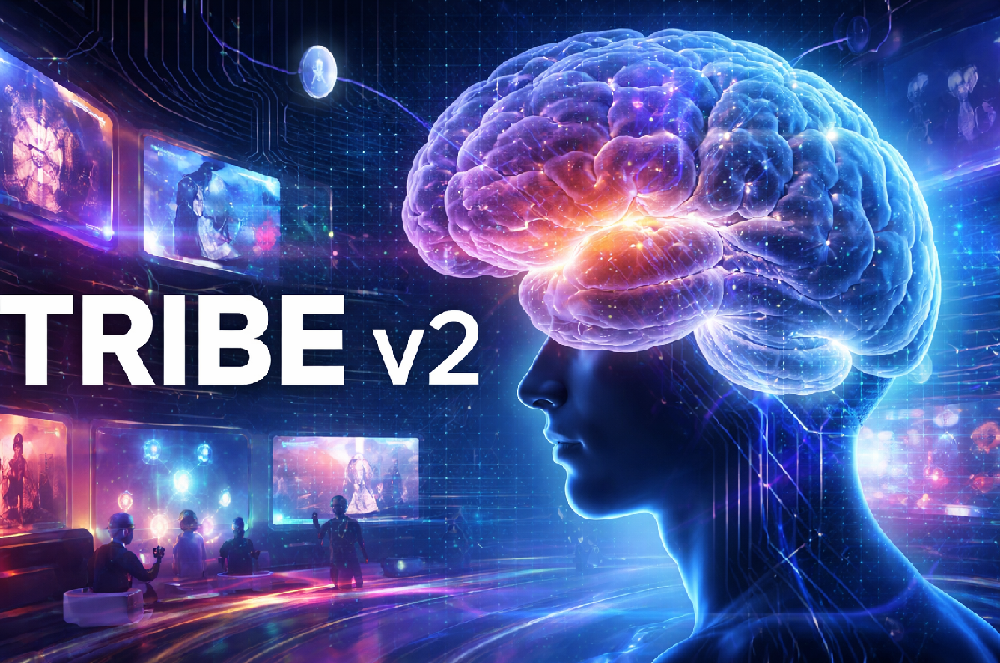
Meta’s Fundamental AI Research team has released a foundation model that predicts how the human brain responds to sight, sound, and language — and it could change neuroscience forever.
“A foundation model trained to predict how the human brain responds to almost any sight or sound — enabling a digital twin of neural activity at scale.”
— Meta AI at FAIR, March 2026What is TRIBE v2?
TRIBE stands for TRimodal Brain Encoder. The original TRIBE model secured first place at the prestigious Algonauts 2025 brain modeling competition, featuring a one-billion-parameter architecture. TRIBE v2 is its successor—not just an incremental improvement, but a significant leap forward as a foundation model trained on substantially more data, delivering dramatically higher-resolution predictions.
Released on March 26, 2026, by Meta’s Fundamental AI Research (FAIR) team, TRIBE v2 takes any stimulus — an image, a video clip, an audio recording, or even a passage of text — and outputs a predicted fMRI response pattern across the entire brain. In essence, it simulates what your brain would “feel” when encountering that content.
The architecture: how does it work?
TRIBE v2 uses a Transformer-based approach similar in spirit to large language models, but adapted for multi-modal processing. Where LLMs process tokens of text, TRIBE v2 processes tokens of perception — visual, auditory, and linguistic simultaneously.
The model targets two key processing pathways identified in neuroscience: the ventral visual stream (associated with object recognition and visual semantics) and the auditory stream (associated with processing sound and speech). By aligning AI-extracted features with actual human brain patterns, TRIBE v2 learns to serve as a computational proxy for the biological mind.
Zero-shot predictions: the biggest breakthrough
Perhaps the most scientifically significant capability of TRIBE v2 is zero-shot generalization. Previous brain modeling approaches required per-subject training data — you had to scan someone to model them. TRIBE v2 can predict brain responses for individuals it has never encountered.
- Predicts responses for new, unseen subjects without prior scanning
- Generalizes to unseen languages — cross-lingual brain modeling at scale
- Works on novel task types — 2–3× better accuracy than prior methods
- TRIBE v2 predictions can sometimes align more closely with group-average neural activity than a single individual’s own fMRI scan
What can TRIBE v2 actually do?
The applications of a model like TRIBE v2 span neuroscience research, clinical medicine, AI development, and — yes — consumer technology. Here’s where researchers and industry observers see the biggest opportunities:
Run thousands of virtual brain experiments in seconds — no fMRI scanner required. Months of lab work compressed to computation.
Faster diagnosis and hypothesis testing for conditions like aphasia, epilepsy, and other language or sensory disorders.
Inform BCI design by predicting how users will neurologically respond to different interface stimuli before any device is built.
Use neural response patterns to improve how AI systems perceive and understand multimodal content — making models more human-aligned.
Why this matters for AI development
Most foundation models are trained on internet text, images, or human-generated data. TRIBE v2 represents an entirely new category: a foundation model trained on the neural responses of the human brain itself. This is not a trivial distinction.
When an AI system learns from fMRI data, it learns something no text corpus can teach — how perception actually unfolds in biological neural tissue. The patterns TRIBE v2 internalizes are the patterns evolution spent millions of years refining. That makes it a uniquely valuable source of grounding for building AI that is more perceptually coherent and semantically robust.
For the broader AI field, TRIBE v2 opens a new research direction: using predicted brain data to augment AI training, validate multimodal representations, and measure how “human-like” a model’s internal representations actually are.
Conclusion
Final take
A new era of computational neuroscience
A new era of computational neuroscience
TRIBE v2 is not just an impressive technical achievement — it is a paradigm shift in how we study the brain. For decades, neuroscience has been bottlenecked by the slow, expensive, and physically demanding process of collecting fMRI data. A single experiment could take months from scanning to publication.
TRIBE v2 compresses that pipeline dramatically. Researchers can now simulate brain responses to thousands of stimuli without a single scan, validate hypotheses computationally before committing lab resources, and build on a shared, open-access foundation model that improves with community use.
For the AI community, TRIBE v2 offers something rarer still: a window into biological intelligence. As the lines between AI research and neuroscience continue to blur, models like TRIBE v2 will become essential infrastructure — not just for understanding the human brain, but for building machines that work more like it.
The brain is the most sophisticated information processing system we know. TRIBE v2 is our best attempt yet to read its patterns — and that changes everything.



No responses yet