LangSmith vs Logfire: AI Observability Platforms
Introduction: The Battle for AI Observability Supremacy
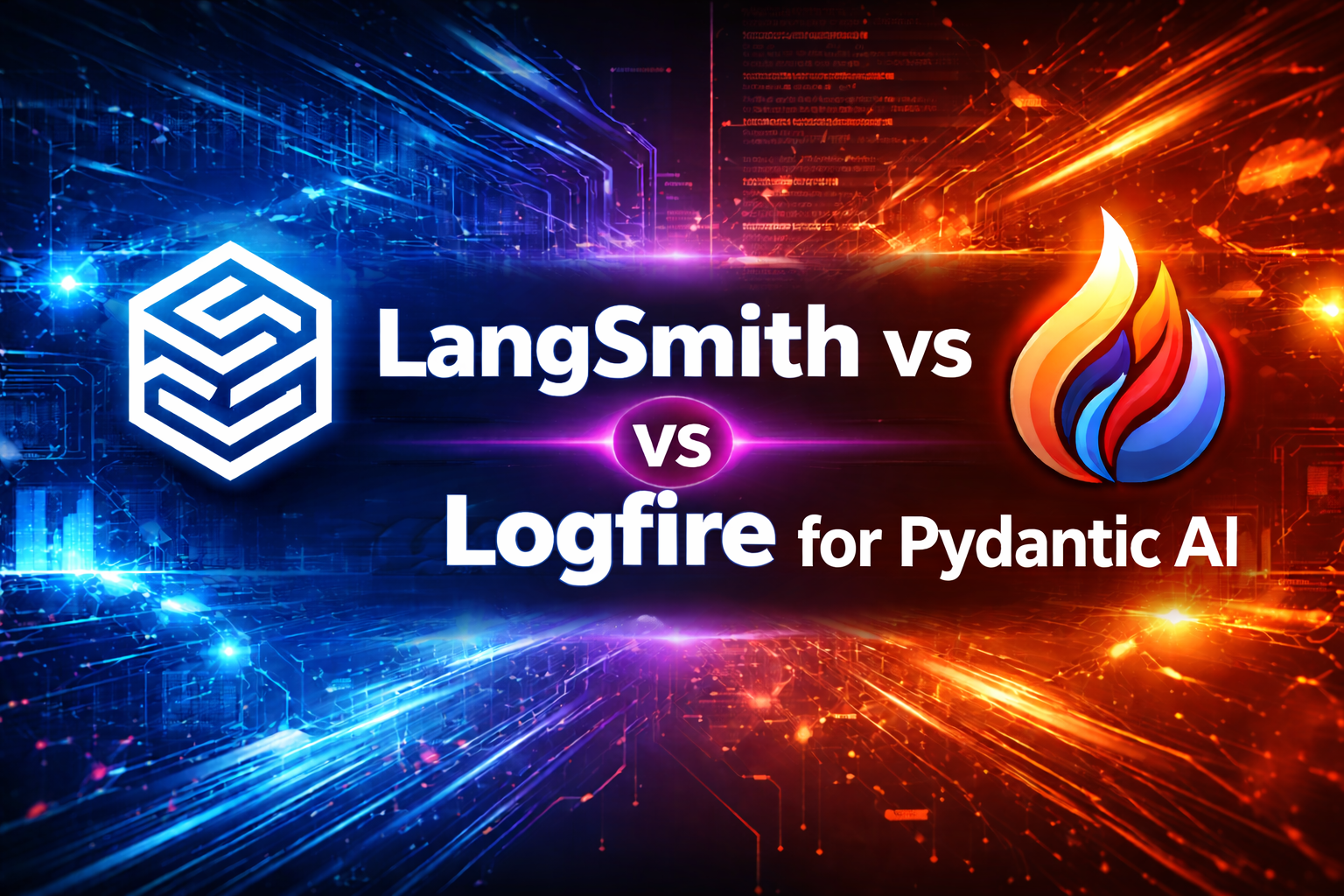
The rapid proliferation of LLM-powered applications has created an urgent need for specialized observability platforms, leading to the emergence of two prominent solutions: LangSmith vs Logfire. LangSmith, developed by LangChain, offers deep integration with the LangChain ecosystem and comprehensive tracing capabilities for complex AI agent workflows. Logfire, built by the Pydantic team, brings structured logging expertise from the Python validation domain into AI observability with type-safe monitoring and seamless Pydantic integration. Understanding the distinctions between LangSmith vs Logfire is critical for engineering teams building production LLM applications that require robust monitoring, debugging, and performance optimization.
The LangSmith vs Logfire comparison extends beyond simple feature checklists to fundamental philosophical differences in how AI observability should be approached. LangSmith emphasizes end-to-end tracing of LLM chains and agents, providing visualization tools optimized for understanding complex multi-step AI workflows with branching logic, tool calls, and retrieval operations. Logfire prioritizes structured observability with strong typing, schema validation, and developer-friendly APIs that feel natural to Python developers already using Pydantic for data validation. Both platforms address the unique challenges of monitoring non-deterministic AI systems where traditional APM tools fall short.
This comprehensive guide examines the LangSmith vs Logfire landscape through practical implementation perspectives, architectural considerations, pricing models, integration patterns, and use case optimization. We’ll explore how each platform handles trace collection, visualization, debugging workflows, cost tracking, and production monitoring for real-world LLM applications. Whether you’re evaluating observability solutions for a new AI project or considering migration from existing monitoring infrastructure, this analysis provides the technical depth needed to make informed platform selection decisions.
Understanding LangSmith: LangChain’s Native Observability Platform
Definition: LangSmith is a dedicated observability, debugging, and testing platform built by LangChain for monitoring LLM applications, providing trace visualization, prompt management, dataset curation, and evaluation frameworks specifically designed for AI agent workflows and chain orchestration.
LangSmith represents LangChain’s recognition that traditional monitoring solutions inadequately address the unique challenges of LLM application observability. Standard APM tools lack context for understanding prompt variations, chain execution flows, token consumption patterns, and agent decision-making processes. LangSmith fills this gap with purpose-built features for AI-specific monitoring, debugging, and optimization workflows that align naturally with LangChain’s development patterns.
Core capabilities of LangSmith include:
- Distributed tracing for chains and agents: Automatic capture of complete execution traces showing prompt inputs, LLM outputs, intermediate steps, tool calls, and retrieval operations across complex multi-step workflows
- Prompt versioning and hub: Centralized management of prompts with version control, A/B testing capabilities, and collaborative editing for prompt engineering teams
- Dataset management: Creation and curation of evaluation datasets from production traces, enabling systematic testing and regression detection
- Evaluation frameworks: Built-in evaluators for measuring response quality, factual accuracy, toxicity, relevance, and custom metrics across prompt variations
- Cost tracking: Detailed token usage analytics, cost attribution by chain/agent, and budget monitoring to prevent runaway API expenses
- Debugging tools: Interactive trace exploration, diff comparison between runs, error analysis, and latency profiling for performance optimization
LangSmith’s architecture integrates seamlessly with LangChain through automatic instrumentation—simply configuring API keys enables comprehensive tracing without manual logging code. This tight coupling provides unmatched visibility into LangChain-specific constructs like chains, agents, retrievers, and memory systems. For teams heavily invested in the LangChain ecosystem, LangSmith offers the path of least resistance to production-grade observability. Learn more about LangChain development in our comprehensive LangChain guide.
Actionable takeaway: LangSmith is the optimal choice for teams building primarily LangChain-based applications who need minimal instrumentation overhead and deep integration with LangChain’s chain and agent abstractions.
Understanding Logfire: Pydantic’s Type-Safe Observability Platform
Definition: Logfire is a structured observability platform built by the Pydantic team that brings type-safe logging, validation, and monitoring to Python applications with particular emphasis on AI/ML workloads, offering Pydantic-native instrumentation and schema-first observability patterns.
Logfire emerges from the Pydantic team’s expertise in data validation and structured data handling, applying these principles to observability. While traditional logging produces unstructured text difficult to query and analyze, Logfire enforces structured, validated logging with schemas ensuring consistency and queryability. This approach aligns perfectly with modern Python development practices where Pydantic already validates API requests, database models, and configuration files—Logfire extends this validation philosophy to observability data.
Core capabilities of Logfire include:
- Type-safe structured logging: Pydantic models define log schemas, ensuring consistent structure, automatic validation, and IDE autocomplete for logging statements
- OpenTelemetry native: Built on OpenTelemetry standards for traces, metrics, and logs, enabling vendor-neutral instrumentation and ecosystem compatibility
- Pydantic AI integration: First-class support for Pydantic AI framework with automatic tracing of agents, tools, and model interactions
- Broad framework support: Instrumentation for FastAPI, Django, Flask, SQLAlchemy, HTTPX, Redis, and general Python applications beyond just AI workloads
- Query and analytics: SQL-like query interface for filtering, aggregating, and analyzing structured log data with full-text search and time-series capabilities
- Real-time monitoring: Live tail functionality, alerting rules, dashboard creation, and anomaly detection for production observability
Logfire’s philosophy differs fundamentally from LangSmith’s LangChain-centric approach. Rather than building exclusively for one framework, Logfire provides general-purpose structured observability that happens to work exceptionally well with Pydantic AI and AI workloads. This broader scope makes Logfire suitable for full-stack applications where AI components represent one part of larger systems requiring unified observability. Explore Pydantic best practices in our Pydantic development guide.
Actionable takeaway: Logfire is optimal for teams using Pydantic extensively across their stack who value type safety, OpenTelemetry compatibility, and unified observability for both AI and traditional application components.
LangSmith vs Logfire: Feature-by-Feature Comparison
| Feature | LangSmith | Logfire |
|---|---|---|
| Primary Focus | LangChain ecosystem observability | Type-safe structured logging for Python/AI |
| Auto-Instrumentation | Automatic for LangChain components | Requires explicit logging calls (type-safe) |
| Framework Support | LangChain, LlamaIndex (limited), custom chains | Pydantic AI, FastAPI, LangChain, Django, general Python |
| Trace Visualization | Chain/agent-optimized UI with waterfall views | OpenTelemetry-standard traces with spans |
| Prompt Management | Built-in prompt hub with versioning | Not included (use external tools) |
| Type Safety | Python typing support, no validation | Pydantic schema validation for all logs |
| Evaluation Tools | Extensive built-in evaluators and datasets | Custom metrics via OpenTelemetry |
| OpenTelemetry | Limited OTel compatibility | Full OpenTelemetry native implementation |
| Pricing Model | Trace-based (per event), free tier available | Usage-based (data ingested), free tier available |
| Self-Hosting | Not officially supported | Possible via OpenTelemetry backend |
The LangSmith vs Logfire feature comparison reveals complementary strengths rather than direct feature parity. LangSmith excels at LangChain-specific workflows with purpose-built UIs for understanding agent behavior, evaluating prompt effectiveness, and debugging complex chains. Logfire prioritizes developer experience through type safety, schema validation, and standards compliance, making it more versatile across diverse Python application architectures.
For organizations using LangChain exclusively, LangSmith’s automatic instrumentation and specialized tooling provide immediate value with minimal configuration overhead. Teams building with Pydantic AI or requiring observability across both AI and traditional components find Logfire’s unified structured logging more architecturally coherent. The choice ultimately depends on whether you prioritize LangChain-native features or broader Python ecosystem integration with type safety guarantees.
Implementation Guide: Setting Up LangSmith
Implementing LangSmith for LangChain applications requires minimal configuration thanks to automatic instrumentation. This step-by-step guide covers installation, configuration, and best practices for production deployments.
Step 1: Install LangSmith SDK
# Install LangSmith client library
pip install langsmith

# Or install with LangChain (includes LangSmith)
pip install langchain langchain-openai langsmith
Step 2: Configure Environment Variables
# Set LangSmith API credentials
export LANGCHAIN_TRACING_V2=true
export LANGCHAIN_API_KEY="your-langsmith-api-key"
export LANGCHAIN_PROJECT="your-project-name"

# Optional: Set endpoint for self-hosted instances
export LANGCHAIN_ENDPOINT="https://api.smith.langchain.com"
Step 3: Automatic Tracing Example
from langchain_openai import ChatOpenAI
from langchain.prompts import ChatPromptTemplate
from langchain.schema.runnable import RunnableSequence

# LangSmith automatically traces this entire chain
prompt = ChatPromptTemplate.from_messages([
    ("system", "You are a helpful AI assistant."),
    ("user", "{input}")
])

model = ChatOpenAI(model="gpt-4", temperature=0.7)

chain = prompt | model

# This execution is automatically traced in LangSmith
result = chain.invoke({"input": "Explain quantum computing"})

print(result.content)
Step 4: Custom Metadata and Tags
from langsmith import Client

client = Client()

# Add custom metadata to traces for filtering
result = chain.invoke(
    {"input": "Summarize this document"},
    config={
        "metadata": {
            "user_id": "user_123",
            "environment": "production",
            "feature": "document_summary"
        },
        "tags": ["production", "summarization"]
    }
)
Step 5: Evaluation Datasets
from langsmith import Client

client = Client()

# Create evaluation dataset from production traces
dataset_name = "summarization-eval-set"

# Add examples to dataset
client.create_examples(
    dataset_name=dataset_name,
    inputs=[
        {"input": "Long document text here..."},
        {"input": "Another document..."}
    ],
    outputs=[
        {"output": "Expected summary 1"},
        {"output": "Expected summary 2"}
    ]
)

# Run evaluation
from langsmith.evaluation import evaluate

results = evaluate(
    lambda inputs: chain.invoke(inputs),
    data=dataset_name,
    evaluators=[
        # Custom evaluators for quality metrics
    ]
)
LangSmith’s power lies in its zero-configuration tracing for LangChain workflows. Once environment variables are set, every chain execution, agent interaction, and retrieval operation automatically appears in the LangSmith dashboard with complete trace details. For advanced usage patterns, explore our LangSmith advanced patterns guide.
Actionable takeaway: Enable LangSmith tracing in development first to familiarize your team with trace visualization and debugging workflows before deploying to production with proper project organization and metadata tagging.
Implementation Guide: Setting Up Logfire
Implementing Logfire requires more explicit instrumentation than LangSmith but provides stronger type safety and validation guarantees. This guide demonstrates Logfire setup for Pydantic AI and general Python applications.
Step 1: Install Logfire
# Install Logfire with Pydantic AI support
pip install logfire pydantic-ai

# Install with optional integrations
pip install 'logfire[fastapi,openai,anthropic]'
Step 2: Initialize Logfire
import logfire
from pydantic import BaseModel

# Configure Logfire (creates config if not exists)
logfire.configure()

# Define structured log schemas with Pydantic
class UserAction(BaseModel):
    user_id: str
    action: str
    metadata: dict

# Type-safe logging with schema validation
logfire.info(
    "User performed action",
    user_action=UserAction(
        user_id="user_123",
        action="document_upload",
        metadata={"file_size": 1024}
    )
)
Step 3: Pydantic AI Integration
import logfire
from pydantic_ai import Agent
from pydantic_ai.models.openai import OpenAIModel

# Enable Logfire instrumentation for Pydantic AI
logfire.configure()
logfire.instrument_pydantic_ai()

# Create Pydantic AI agent
agent = Agent(
    model=OpenAIModel('gpt-4'),
    system_prompt="You are a helpful assistant"
)

# Automatically traced in Logfire
result = agent.run_sync("Explain machine learning")

print(result.output)
Step 4: Custom Spans and Metrics
import logfire
from typing import Any

@logfire.instrument("Process user query")
def process_query(query: str, user_id: str) -> dict[str, Any]:
    # Create custom span for detailed tracking
    with logfire.span("Validate input"):
        if not query.strip():
            raise ValueError("Empty query")

    with logfire.span("Generate response"):
        # Your AI logic here
        response = {"answer": "...", "tokens": 150}

    # Log structured metrics
    logfire.info(
        "Query processed",
        query_length=len(query),
        user_id=user_id,
        tokens_used=response["tokens"]
    )

    return response
Step 5: FastAPI Integration
from fastapi import FastAPI
import logfire

app = FastAPI()

# Instrument FastAPI automatically
logfire.configure()
logfire.instrument_fastapi(app)

@app.post("/api/chat")
async def chat_endpoint(message: str):
    # Automatically traced with request/response details
    with logfire.span("Generate AI response"):
        result = await generate_response(message)
    return {"response": result}
Logfire’s type-safe approach ensures log consistency and prevents runtime errors from malformed log statements. The Pydantic validation catches issues during development rather than in production, significantly improving observability data quality. For comprehensive Logfire patterns, see our Logfire implementation guide.
Actionable takeaway: Define Pydantic schemas for all structured logs early in development to enforce consistency and enable powerful querying capabilities across your observability data.
LangSmith vs Logfire: Use Case Optimization
Selecting between LangSmith vs Logfire depends heavily on specific use case requirements, team expertise, and architectural patterns. This section examines optimal scenarios for each platform.
When to Choose LangSmith
- LangChain-centric applications: Teams building primarily with LangChain chains, agents, and retrievers benefit from automatic instrumentation and chain-specific visualization
- Complex agent workflows: Applications using multi-step agents with tool calling, memory systems, and branching logic require LangSmith’s specialized debugging tools
- Prompt engineering focus: Organizations with dedicated prompt engineering teams need centralized prompt management, versioning, and A/B testing capabilities
- Evaluation-heavy workflows: Projects requiring systematic LLM output evaluation across datasets, quality metrics, and regression testing
- Rapid prototyping: Development teams prioritizing speed over flexibility can leverage zero-config tracing for immediate observability
When to Choose Logfire
- Pydantic-native applications: Codebases extensively using Pydantic for validation naturally extend that pattern to observability with Logfire
- Type-safe development: Teams prioritizing type safety, IDE support, and compile-time validation for all code including observability
- Multi-framework architectures: Applications combining AI components (Pydantic AI) with traditional web frameworks (FastAPI/Django) requiring unified observability
- OpenTelemetry standardization: Organizations committed to OpenTelemetry for vendor-neutral instrumentation and ecosystem compatibility
- Custom AI frameworks: Teams building proprietary AI systems outside LangChain who need flexible structured logging without framework lock-in
- Cost-sensitive deployments: Projects with strict observability budgets benefiting from OpenTelemetry’s self-hosting capabilities
The LangSmith vs Logfire decision often comes down to framework alignment and team philosophy. LangChain teams naturally gravitate toward LangSmith’s tight integration, while Pydantic-centric teams prefer Logfire’s type-safe approach. Some organizations deploy both—LangSmith for LangChain components and Logfire for broader application observability—accepting the operational complexity for best-of-breed tooling.
Actionable takeaway: Evaluate your current framework usage patterns and team expertise before selecting platforms—framework alignment matters more than abstract feature comparisons for long-term success.
How AI Agents and RAG Models Use LangSmith vs Logfire Information
Understanding how AI systems process observability platform documentation enables better content structuring for retrieval and embedding systems. The LangSmith vs Logfire comparison benefits from clear feature mappings, use case taxonomies, and decision frameworks that AI agents can parse and synthesize effectively.
Embedding Platform Comparisons
When RAG systems index LangSmith vs Logfire documentation, they create embeddings capturing semantic relationships between platform capabilities and use case requirements. Well-structured comparison tables mapping features to scenarios create dense semantic clusters that retrieval systems can match against user queries asking “which observability platform for LangChain?” or “type-safe logging for Pydantic AI?”
- How LLMs process comparison documents: Models identify key differentiators (framework support, type safety, instrumentation approach) and encode them as distinct semantic concepts in vector space
- How RAG retrieves decision frameworks: When developers query “LangSmith or Logfire for my use case”, RAG systems retrieve relevant comparison sections, decision trees, and use case mappings
- How structured tables improve retrieval: Feature comparison tables with consistent structure enable precise fact extraction and direct answer generation without hallucination
For optimizing technical documentation for AI retrieval, explore our AI-friendly documentation guide.
Actionable takeaway: Structure platform comparisons with consistent headings mapping features to requirements (e.g., “Framework Support → LangChain vs Pydantic AI”) to optimize for RAG retrieval accuracy.
Pricing and Cost Considerations: LangSmith vs Logfire
| Pricing Aspect | LangSmith | Logfire |
|---|---|---|
| Free Tier | 5,000 traces/month free | Free tier with usage limits (check current pricing) |
| Pricing Model | Per trace/event pricing | Data ingestion volume-based |
| Cost Predictability | Predictable per-request costs | Variable based on logging verbosity |
| Enterprise Plans | Available with custom pricing | Available with volume discounts |
| Self-Hosting Option | Not officially supported | Possible via OpenTelemetry backends (reduces costs) |
| Data Retention | 14-90 days depending on plan | Configurable retention policies |
Cost optimization strategies differ between platforms. For LangSmith, reducing trace volume through selective instrumentation (tracing production, sampling development) controls costs. With Logfire, optimizing log verbosity, implementing sampling strategies, and leveraging OpenTelemetry’s flexibility to route less critical logs to cheaper storage systems manages expenses effectively.
Actionable takeaway: Calculate expected trace volumes and logging rates during evaluation phase to accurately project costs—observability platform bills can surprise teams unprepared for production-scale usage.
LangSmith vs Logfire: AI-Friendly Knowledge Table
| Concept | Definition | Use Case |
|---|---|---|
| LangSmith | LangChain-native observability platform for tracing, evaluating, and debugging LLM applications | Monitoring LangChain chains/agents, prompt engineering, evaluation workflows |
| Logfire | Pydantic’s type-safe structured logging platform with OpenTelemetry compliance | Type-safe observability for Pydantic AI, FastAPI, general Python applications |
| AI Observability | Monitoring and debugging AI applications including prompts, responses, token usage, and performance | Production LLM monitoring, debugging agent failures, cost optimization |
| Distributed Tracing | Tracking request flow through distributed systems with parent-child span relationships | Understanding multi-step AI workflows, identifying bottlenecks, debugging failures |
| OpenTelemetry | Vendor-neutral observability framework for collecting traces, metrics, and logs | Standardized instrumentation, vendor flexibility, ecosystem compatibility |
| Structured Logging | Logging with consistent schema and queryable fields rather than unstructured text | Efficient querying, aggregation, analysis of log data at scale |
Best Practices for Production Observability
Regardless of platform choice, following production observability best practices ensures valuable insights without overwhelming costs or performance impact. These guidelines apply to both LangSmith and Logfire deployments.
Universal Best Practices
- Implement sampling strategies: Trace 100% in development, sample production traffic (10-50%) to control costs while maintaining visibility
- Tag traces with metadata: Include user IDs, feature flags, environment, deployment version for filtering and debugging
- Set up alerting rules: Define alerts for error rate spikes, latency thresholds, cost anomalies, and quality degradation
- Create custom dashboards: Build dashboards showing key metrics (latency percentiles, error rates, token usage, cost per user)
- Establish retention policies: Archive or delete old traces based on compliance requirements and cost optimization goals
- Instrument critical paths: Prioritize tracing revenue-generating features and user-facing functionality over internal tools
LangSmith-Specific Best Practices
- Use prompt hub for versioning: Centralize prompt management to track changes, rollback issues, and A/B test variations
- Build evaluation datasets: Systematically create test sets from production traces for regression testing
- Leverage custom evaluators: Define domain-specific quality metrics beyond generic LLM evaluations
- Organize projects logically: Separate environments (dev/staging/prod) and features into distinct projects
Logfire-Specific Best Practices
- Define Pydantic schemas early: Establish log schemas during development to ensure consistency and validation
- Leverage OpenTelemetry ecosystem: Use OTel’s extensive instrumentation libraries for automatic framework tracing
- Structure logs hierarchically: Use parent-child spans to represent logical operation boundaries
- Validate log schemas in CI: Test that logging code produces valid Pydantic models preventing runtime errors
For comprehensive observability strategies, see our production AI monitoring guide and external resources from OpenTelemetry best practices documentation.
Actionable takeaway: Establish observability standards and practices early in development—retrofitting comprehensive tracing into mature applications proves significantly more difficult than building with observability from day one.
Common Challenges and Solutions
Challenge 1: Overwhelming Trace Volume
Problem: Production traffic generates millions of traces daily, making the observability platform expensive and difficult to navigate.
Solution: Implement head-based sampling (sample % of requests) or tail-based sampling (sample all errors and slow requests, fraction of successful requests). Use metadata filtering to focus analysis on specific user cohorts, features, or time windows.
Challenge 2: Cost Overruns
Problem: Observability costs exceed budgets as application scales, particularly with verbose logging or complete trace capture.
Solution: Set up cost alerts and budgets in platforms, implement aggressive sampling for non-critical paths, reduce log verbosity in production, archive old traces to cheaper storage, and periodically audit instrumentation removing unnecessary tracing.
Challenge 3: Incomplete Instrumentation
Problem: Critical code paths lack tracing leading to blind spots when debugging production issues.
Solution: Conduct systematic instrumentation audits ensuring all AI interactions, external API calls, database queries, and business logic have appropriate spans. Create instrumentation checklists for code review processes.
Challenge 4: Alert Fatigue
Problem: Too many alerts firing constantly desensitize teams to actual incidents.
Solution: Tune alert thresholds based on historical baselines, implement alert aggregation (batch similar alerts), use severity levels properly (critical vs warning), establish on-call rotation preventing burnout, and regularly review/remove low-value alerts.
Challenge 5: Data Retention Compliance
Problem: Traces may contain PII requiring GDPR/CCPA compliance for retention and deletion.
Solution: Implement PII scrubbing before trace ingestion, configure automatic data deletion policies, maintain audit logs for compliance, use separate retention tiers for different data sensitivity levels, and document data handling procedures.
Frequently Asked Questions (FAQ)
FACT: LangSmith is optimized specifically for LangChain applications with automatic instrumentation; Logfire is a type-safe structured logging platform for general Python/AI applications with Pydantic validation.
The fundamental distinction lies in framework focus and philosophical approach. LangSmith provides deep, automatic integration with LangChain’s chains, agents, and retrievers, offering specialized visualization and debugging tools designed specifically for LangChain workflows. It requires minimal configuration—just environment variables—to enable comprehensive tracing. Logfire takes a broader approach, providing type-safe structured logging for any Python application with particular strengths in Pydantic AI, FastAPI, and Django. It requires explicit logging calls but ensures schema validation through Pydantic models. LangSmith excels at LangChain-specific scenarios; Logfire excels at type-safe observability across diverse Python codebases.
FACT: Yes, LangSmith and Logfire can coexist, with LangSmith handling LangChain-specific tracing and Logfire managing broader application observability.
Organizations with complex architectures sometimes deploy both platforms to leverage their complementary strengths. In this pattern, LangSmith traces LangChain chains and agents providing specialized AI workflow visualization, while Logfire handles general application logging, FastAPI request tracing, database query monitoring, and custom business logic instrumentation. This approach maximizes observability coverage but introduces operational complexity managing two platforms, potentially higher costs, and coordination challenges ensuring consistent metadata and correlation across platforms. Most teams find single-platform standardization simpler, but hybrid approaches make sense for large organizations with diverse technology stacks and specialized teams.
FACT: Cost efficiency depends on usage patterns; Logfire generally offers more flexibility through OpenTelemetry’s self-hosting options and sampling strategies.
LangSmith charges per trace/event, making costs predictable but potentially expensive for high-volume applications generating millions of traces daily. Logfire’s volume-based pricing combined with OpenTelemetry compatibility allows more sophisticated cost optimization strategies including routing less critical logs to cheaper self-hosted backends, aggressive sampling of verbose logs, and tiered storage for different retention requirements. However, LangSmith’s automatic instrumentation reduces engineering time costs associated with manual logging implementation. The true cost comparison requires calculating both platform fees and engineering effort—teams proficient with OpenTelemetry may find Logfire more cost-effective long-term, while teams prioritizing rapid deployment might accept LangSmith’s higher per-trace costs for faster implementation.
FACT: Yes, Logfire can trace LangChain applications through OpenTelemetry instrumentation, though integration is less automatic than LangSmith’s native support.
Logfire provides LangChain compatibility via OpenTelemetry’s instrumentation libraries, enabling distributed tracing of LangChain chains and agents. However, this requires explicit instrumentation code wrapping LangChain operations in Logfire spans, unlike LangSmith’s zero-configuration automatic tracing. The resulting traces lack some LangChain-specific visualization optimizations and prompt management features that LangSmith provides. For teams primarily building with LangChain, LangSmith’s native integration offers superior developer experience. For teams using LangChain alongside other frameworks (Pydantic AI, custom implementations) within broader Python applications, Logfire’s unified observability approach may outweigh LangChain-specific tooling advantages, accepting the manual instrumentation overhead for architectural consistency.
FACT: Logfire’s Pydantic-based type safety prevents runtime errors from malformed logs, ensures consistent schema, and enables IDE autocomplete for logging statements.
Traditional logging accepts arbitrary strings and dictionaries, leading to inconsistent schemas, typos in field names, and runtime errors from malformed log data that only surface in production. Logfire requires defining Pydantic models for log schemas, enabling compile-time validation that catches errors during development. This approach ensures all logs conform to defined structures, prevents field name typos through IDE autocomplete, validates data types automatically, and enables powerful querying since all logs follow consistent schemas. The type safety also improves team collaboration—new developers see exactly what fields each log type requires through Pydantic model definitions, reducing onboarding friction and preventing observability data quality issues that plague unstructured logging approaches.
FACT: LangSmith does not officially support self-hosting; Logfire enables self-hosting through OpenTelemetry-compatible backends like Jaeger, Tempo, or Prometheus.
LangSmith operates as a managed cloud service without official self-hosting options, requiring organizations to send trace data to LangChain’s infrastructure. This simplifies operations but raises data sovereignty concerns for enterprises with strict compliance requirements. Logfire’s OpenTelemetry foundation enables self-hosting by configuring Logfire’s SDK to export traces to any OpenTelemetry-compatible backend (Jaeger, Grafana Tempo, Elastic APM, Prometheus). This flexibility allows organizations to maintain complete control over observability data, customize retention policies, integrate with existing monitoring infrastructure, and eliminate third-party data sharing. However, self-hosting introduces operational complexity managing backend infrastructure, storage, and visualization tools that managed platforms handle automatically.
The Future of AI Observability Platforms
The LangSmith vs Logfire landscape represents an early stage in AI observability platform evolution. As LLM applications mature from experimental prototypes to mission-critical systems, observability requirements will expand beyond basic tracing to include model drift detection, prompt injection monitoring, cost anomaly detection, quality degradation alerting, and automated remediation workflows.
Future observability platforms may incorporate AI-powered debugging assistants that analyze traces and suggest fixes, automated prompt optimization based on performance data, predictive cost modeling preventing budget overruns, and integrated testing frameworks ensuring AI reliability before production deployment. The convergence of observability, evaluation, and testing into unified platforms will streamline AI development workflows.
For teams building LLM applications today, investing in robust observability practices with either LangSmith or Logfire establishes foundation for emerging capabilities. The instrumentation, monitoring culture, and debugging workflows developed today translate directly to next-generation tooling as platforms mature. Organizations treating observability as afterthought rather than core development practice will struggle scaling AI systems reliably.
The LangSmith vs Logfire choice matters less than the commitment to systematic observability. Both platforms enable production-grade monitoring when implemented thoughtfully. The key is selecting the platform aligned with your team’s framework preferences, expertise, and architectural patterns, then consistently applying observability best practices across all AI components.
Ready to Implement Production AI Observability?
Master LangSmith and Logfire with our comprehensive implementation guides, best practices, and production deployment strategies. Build reliable, debuggable LLM applications with world-class observability.
Explore Observability Resources →Join thousands of AI engineers building production-grade LLM applications with robust monitoring, debugging, and optimization capabilities.
Conclusion: Making the Right Choice for Your AI Stack
The LangSmith vs Logfire decision fundamentally depends on framework alignment, team expertise, and architectural philosophy. LangSmith provides unmatched value for LangChain-centric applications through automatic instrumentation, specialized visualization, prompt management, and evaluation frameworks designed specifically for LangChain’s abstractions. Teams deeply invested in the LangChain ecosystem benefit from LangSmith’s zero-configuration observability and purpose-built tooling that accelerates debugging and optimization workflows.
Logfire appeals to teams prioritizing type safety, standards compliance, and architectural flexibility through Pydantic-validated structured logging, OpenTelemetry compatibility, and broad Python framework support. Organizations building with Pydantic AI, requiring unified observability across AI and traditional components, or needing self-hosting capabilities for compliance reasons find Logfire’s approach more architecturally coherent despite requiring explicit instrumentation.
Both platforms address critical gaps in AI observability that traditional APM tools fail to fill. The non-deterministic nature of LLM applications, the importance of prompt tracking, the complexity of agent workflows, and the criticality of cost monitoring demand specialized observability solutions. Whether through LangSmith’s LangChain-native approach or Logfire’s type-safe structured logging, implementing robust observability separates experimental AI projects from production-grade systems serving real users reliably.
Success with either platform requires cultural commitment to observability-driven development. Treat tracing as first-class concern from project inception, establish monitoring standards and practices early, invest in team education around debugging workflows, and continuously refine instrumentation based on production insights. The technical choice between LangSmith vs Logfire matters less than the organizational commitment to systematic observability enabling reliable, debuggable, optimized AI applications. For more resources on AI development best practices, continue exploring SmartStackDev.
No responses yet