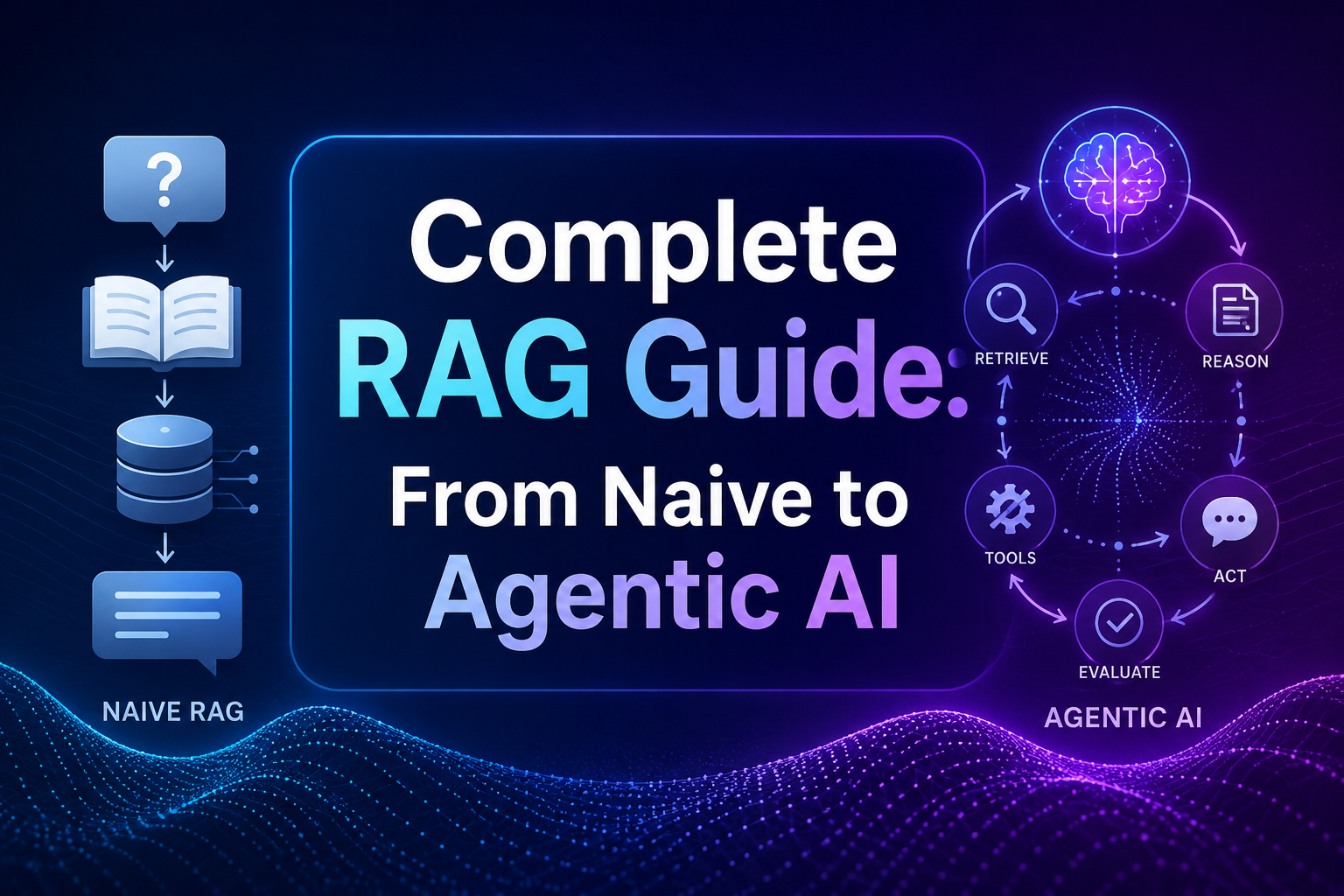
Complete RAG Guide:
From Naive to Agentic AI
Master Retrieval-Augmented Generation from scratch — embeddings, vector databases, GraphRAG, and autonomous Agentic RAG architectures with practical code examples and production best practices.
Intro The Fundamental Problem with LLMs
Large Language Models like GPT-4, Claude, and Gemini possess remarkable capabilities — generating human-like text, reasoning through complex problems, and assisting with countless tasks. Yet they share a critical limitation that undermines their reliability in production: LLMs are frozen in time. Their knowledge represents a static snapshot captured during training, typically months or years old.
They know nothing about your company’s private documents, cannot access real-time information, and when confronted with knowledge gaps, they don’t admit uncertainty — they confidently hallucinate plausible-sounding but factually incorrect answers. An LLM trained in 2023 cannot answer questions about 2026 market data, your internal product specs, or your company’s compliance policies.
Instead of relying solely on memorized training data, RAG-powered systems retrieve relevant information from external knowledge sources — your documents, databases, and up-to-date repositories — and provide that context to the LLM before generation. This guide takes you from RAG fundamentals through 2026 advancements including GraphRAG and Agentic RAG architectures reshaping enterprise AI. For complementary context on efficient model deployment, see our guide on Gemma 4 optimisation for Edge AI.
01 Core Concepts: The Three Pillars of RAG
Understanding RAG requires mastering three foundational concepts that every retrieval-augmented system is built on. These pillars work together to transform unstructured text into searchable knowledge LLMs can leverage for accurate, grounded responses.
Embeddings: Capturing Meaning as Mathematics
Embedding models trained on billions of text examples learn to represent semantic meaning numerically. “River bank” and “shoreline” produce similar vectors despite using different words, while “river bank” and “financial bank” produce distant vectors despite sharing a term. Modern embedding models like OpenAI’s text-embedding-3-large, Cohere’s embed-v3, and open-source Sentence Transformers convert text into dense vectors capturing nuanced meaning.
Vector Databases: Storing and Searching Numerical Meaning
Vector databases like Pinecone, Weaviate, Qdrant, Milvus, and Chroma enable approximate nearest neighbor search at massive scale. When a RAG system receives “How do I cancel my subscription?”, the vector database finds chunks titled “Account Termination Policy” — different vocabulary, identical meaning. This semantic search capability is what makes RAG dramatically more powerful than keyword-based document retrieval.
Cosine Similarity: Measuring Semantic Closeness
02 The Naive RAG Workflow: Baseline Architecture
Every RAG implementation builds on a three-stage workflow: ingestion, retrieval, and generation. Understanding this baseline architecture is essential because all advanced techniques are optimizations and extensions of these fundamental stages.
Stage 1: Ingestion — Chunking and Embedding
The ingestion phase processes your documents before any user queries arrive. Large documents get broken into chunks — Naive RAG typically splits every 500 tokens regardless of semantic content. Each chunk is embedded and stored in the vector database alongside metadata. Chunking decisions profoundly impact performance: chunks must be small enough for precise matching yet large enough to preserve context.
Stage 2: Retrieval — Finding Relevant Context
When a user asks a question, the RAG system embeds that question using the same model that embedded the document chunks — ensuring valid semantic comparison. The system searches for the top-K most similar chunks (typically 3–10). In Naive RAG, this retrieval happens once in a straight shot with no refinement — whatever the initial search returns goes directly to generation.
Stage 3: Generation — Creating the Final Response
The final stage assembles a prompt combining the user’s question with all retrieved chunks, then sends it to the LLM. A typical template: “Answer the following question using only the context provided. Context: [chunks]. Question: [question]. Answer:” The LLM synthesizes information across multiple chunks and presents a coherent, grounded answer.
from openai import OpenAI
import pinecone

client = OpenAI(api_key="your-api-key")
pinecone.init(api_key="your-pinecone-key")
index = pinecone.Index("documents")

def naive_rag_query(question: str, top_k: int = 5):
    # Stage 2: Embed the question
    question_embedding = client.embeddings.create(
        model="text-embedding-3-small",
        input=question
    ).data[0].embedding

    # Retrieve top-K similar chunks
    results = index.query(
        vector=question_embedding,
        top_k=top_k,
        include_metadata=True
    )
    retrieved_chunks = [
        match['metadata']['text']
        for match in results['matches']
    ]

    # Stage 3: Build prompt with retrieved context
    context = "\n\n".join(retrieved_chunks)
    prompt = f"""Answer using only the context provided.

Context:
{context}

Question: {question}

Answer:"""

    response = client.chat.completions.create(
        model="gpt-4",
        messages=[{"role": "user", "content": prompt}]
    )
    return response.choices[0].message.content
03 Why Naive RAG Fails in Production
Production deployments quickly expose severe limitations. Industry analysis in 2026 shows that when RAG fails, the failure point is retrieval 73% of the time, not generation. The LLM generates confident, well-structured answers — grounded in the wrong documents.
- Chunking splits sentences mid-thought
- LLM ignores info buried in the middle
- Query-document vocabulary mismatch
- Semantically similar but unhelpful chunks
- No validation before generation
- 40% retrieval failure rate on complex queries
- Semantic chunking preserves structure
- Reranking puts best results first
- Query fusion bridges vocabulary gaps
- Hybrid search adds exact-match precision
- Self-RAG validates before generating
- 90%+ accuracy on complex queries
04 Advanced RAG Architectures (2024–2026)
RAG Fusion and Reranking
RAG Fusion generates multiple query variations: “How do I cancel?” becomes [“How to terminate my subscription”, “Steps for account cancellation”, “Cancel service procedure”]. Each variant is embedded and searched independently, results merged and deduplicated. A reranker like Cohere’s rerank-3 or bge-reranker-large then scores all candidates — selecting only the top 3–5 with highest relevance. Production systems report 15–25% improvements in answer quality from fusion plus reranking.
Hybrid Search: Semantic + Keyword Precision
Vector search excels at semantic matching but struggles with product codes, error messages, and exact-match scenarios where traditional BM25 keyword search remains superior. Hybrid search runs both in parallel, merging results with a weighted combination (typically 70% vector, 30% BM25). This captures semantic relationships while maintaining precision on exact-match queries.
def hybrid_search(query: str, alpha: float = 0.7, top_k: int = 5):
    # Dense (vector) search results
    dense_embedding = get_embedding(query)
    dense_results = index.query(vector=dense_embedding, top_k=top_k * 2)

    # Sparse (BM25) keyword search results
    sparse_vector = bm25.encode_queries(query)
    sparse_results = index.query(sparse_vector=sparse_vector, top_k=top_k * 2)

    # Combine with weighted fusion
    combined_scores = {}
    for match in dense_results['matches']:
        combined_scores[match['id']] = alpha * match['score']

    for match in sparse_results['matches']:
        id = match['id']
        combined_scores[id] = combined_scores.get(id, 0) + (1 - alpha) * match['score']

    sorted_ids = sorted(combined_scores, key=lambda x: combined_scores[x], reverse=True)[:top_k]
    return [get_chunk_by_id(id) for id in sorted_ids]
05 GraphRAG: Adding Relational Intelligence
When a user asks “Which dashboards will break if we deprecate this database table?”, answering requires following a chain: table → queries → reports → dashboards. Naive RAG retrieves isolated chunks but cannot traverse the relationships connecting them. GraphRAG walks the graph to discover all connected entities: dependent queries, downstream reports, impacted dashboards, and their owning teams.
Multi-Hop Reasoning
Answer chains like “Who reports to the VP who joined after 2024?” — impossible with flat retrieval.
Global Queries
Aggregate information across thousands of documents to answer macro-level questions about entire corpuses.
Deterministic Accuracy
Graph queries provide precise, verifiable results — boosting accuracy from 60% to 99% on relationship queries.
Explainable Retrieval
Graph paths show exactly why content was retrieved — transparent citation and trust verification.
Microsoft’s GraphRAG research demonstrated dramatic improvements on complex analytical queries: where Naive RAG achieved 40–60% correctness on multi-hop questions, GraphRAG scored 85–99% by combining semantic search with graph traversal. Implementation requires building a knowledge graph alongside your vector database using tools like Neo4j or Amazon Neptune.
06 Agentic RAG: Self-Correcting Adaptive Systems
Self-RAG and CRAG: Quality Gates and Fallback Mechanisms
Self-RAG introduces quality gates where the system evaluates its own retrieval results before generation. If self-evaluation scores retrieval quality below a threshold, the system rejects results and triggers alternative strategies — rewriting the query, expanding to additional databases, or falling back to web search. CRAG (Corrective RAG) extends this with autonomous correction: analysing why retrieval failed and selecting targeted correction strategies accordingly.
Multimodal RAG: Beyond Text
The latest RAG systems extend beyond text to handle system diagrams, UI screenshots, charts, and tables. A question about “network architecture for the payment service” retrieves not just text descriptions but the actual system diagram showing service dependencies. Implementation requires vision-language embedding models (OpenAI’s CLIP, Google’s SigLIP) and multimodal generation models (GPT-4V, Claude 3.5, Gemini) capable of reasoning across text and visual inputs simultaneously.
07 Production Best Practices
Semantic Chunking Strategies
- Documentation: 512–1024 tokens with 128-token overlap to preserve continuity
- Code: Function-level or class-level chunks using AST parsing — never split mid-function
- Legal / Contracts: Clause-level chunks preserving full contractual meaning
- Parent-Child Chunking: Index small 128-token chunks for precise matching, retrieve 1024-token parent chunks for generation
- Always include metadata: source document, section heading, page number, creation date, author, parent chunk ID
RAGAS Evaluation Metrics
Low Context Precision → fix chunking, add reranking, switch to hybrid search. Low Faithfulness → strengthen prompts, add citation requirements, implement fact-checking. Low Context Recall → expand top-K, try query expansion, audit knowledge base for gaps.
08 RAG vs Fine-Tuning: Choosing the Right Approach
| Dimension | RAG | Fine-Tuning |
|---|---|---|
| Primary Purpose | Teaching new facts, current information | Teaching new skills, behaviors, tone |
| Update Frequency | Real-time — just add documents | Weeks to retrain |
| Cost | Moderate — vector DB + embedding costs | High — GPU training, labeling, storage |
| Explainability | Excellent — cite exact source documents | Poor — model “knows” but can’t cite |
| Hallucination Risk | Low — grounded in retrieved evidence | Higher — may fabricate plausible facts |
| Best Example | “What are our Q4 2025 sales figures?” | “Write emails in our brand voice” |
The decision isn’t either-or — many production systems combine both. Fine-tune a model to write responses in your company’s voice and tone, then use RAG to ensure those responses contain accurate, current facts. Explore how AI frameworks orchestrate both in our comprehensive guide to AI agent frameworks.
FAQ RAG Implementation — Common Questions
Optimal chunk size depends on your content type and query patterns — small chunks (128–256 tokens) work best for specific fact retrieval, large chunks (512–1024 tokens) excel at narrative context, and parent-child chunking bridges this tradeoff.
Start by analysing your query types. Specific fact questions → small chunks for precise matching. Broader procedural questions → larger chunks preserving complete descriptions. Parent-child chunking provides the best of both: index granular 128-token child chunks for precision, but when a child matches, retrieve its 1024-token parent for generation. Always include 10–20% overlap between consecutive chunks. Benchmark multiple sizes using RAGAS metrics on your actual queries.
Vector search alone proves insufficient for production RAG. Hybrid search combining vector semantic matching with BM25 keyword search consistently outperforms vector-only approaches by 15–25% on accuracy metrics, especially for proper nouns, product codes, error messages, or technical terminology.
Production systems implement hybrid search running both methods in parallel, typically using 70% weight on vector scores and 30% on BM25. Modern vector databases like Pinecone, Weaviate, and Qdrant support hybrid search natively.
GraphRAG becomes essential when your use case requires multi-hop reasoning across relationships — answering questions like “Which systems depend on this service?” or “Who reports to executives hired after 2024?” that demand traversing connection chains.
Use GraphRAG for technical documentation with dependency graphs, organizational data requiring hierarchy traversal, regulatory compliance with interconnected requirements, or any domain where understanding connections matters as much as content. Start with vector RAG for simpler use cases; graduate to GraphRAG when relationship questions become mission-critical.
RAG systems hallucinate when generation isn’t constrained to retrieved context — prevention requires strong prompt engineering emphasising faithfulness, citation requirements, lower temperature settings (0.1–0.3), and validation layers checking generated answers against retrieved documents.
Your system prompt must explicitly instruct: “Answer using ONLY information from the provided context. If context is insufficient, say so rather than guessing.” Require citations by asking the LLM to quote relevant passages. Implement post-generation validation with a separate LLM call checking whether the answer contains claims not present in retrieved context. Maintain RAGAS Faithfulness scores above 0.9 as a quality gate.
Traditional RAG executes a fixed linear pipeline (retrieve once, generate once) while Agentic RAG uses an autonomous AI agent that actively controls the retrieval process — deciding when to search, evaluating result quality, generating query variations, and iterating through multiple loops until confident.
In traditional RAG, the system produces an answer regardless of retrieval quality. Agentic RAG’s planning agent evaluates whether retrieved documents actually contain relevant information — if quality is insufficient, it generates refined queries and triggers new searches. It also routes to different backends (vector DB for semantic, knowledge graph for relationships, web search for current events) based on query type. The trade-off: higher accuracy on complex queries at the cost of increased latency and API call costs.
Enterprise RAG implementations typically deliver 3–6 month payback periods through customer support automation (40–60% ticket deflection), knowledge worker productivity gains (20–30% time savings), and reduced hallucination-related errors (90%+ accuracy improvement versus base LLMs).
ROI manifests across multiple dimensions: support chatbots resolving 40–60% of common questions autonomously (saving $5–$15 per resolved ticket), knowledge workers spending 20–30% less time finding information, and 90%+ factual accuracy preventing costly mistakes. Implementation costs: vector DB ($200–$2,000/month), embedding API ($100–$1,000/month), LLM generation ($500–$5,000/month). Organizations with high-volume support or extensive knowledge bases typically achieve positive ROI within one quarter.
↗ RAG as the Foundation of Trustworthy Enterprise AI
Retrieval-Augmented Generation has evolved from a simple technique into the foundational architecture for deploying LLMs in production environments where accuracy, currency, and verifiability matter. By grounding AI responses in retrieved evidence from authoritative sources, RAG transforms unreliable chatbots into trustworthy knowledge systems capable of handling enterprise-critical tasks.
The journey from Naive RAG to Agentic RAG reflects the maturation of the field. Early implementations suffered from chunking artifacts, retrieval precision problems, and hallucination issues. Advanced techniques — query fusion, hybrid search, reranking, semantic chunking, and multimodal retrieval — systematically addressed these limitations, pushing retrieval accuracy from 40% to 90%+ on complex queries. GraphRAG added relationship reasoning. Agentic RAG introduced autonomous control through iterative refinement and self-correction.
Start with solid foundations, graduate to advanced techniques as needs emerge, and let production metrics guide your continuous optimisation. The RAG ecosystem is mature — the tools are ready. The question is whether your architecture is.
Complete 2026 GuideBuild Production-Ready RAG Systems
Transform your LLM applications from unreliable chatbots to trustworthy knowledge systems — expert RAG implementation delivering 90%+ accuracy on complex queries.


No responses yet