What Makes PolyAI Different
from Normal Chatbots?
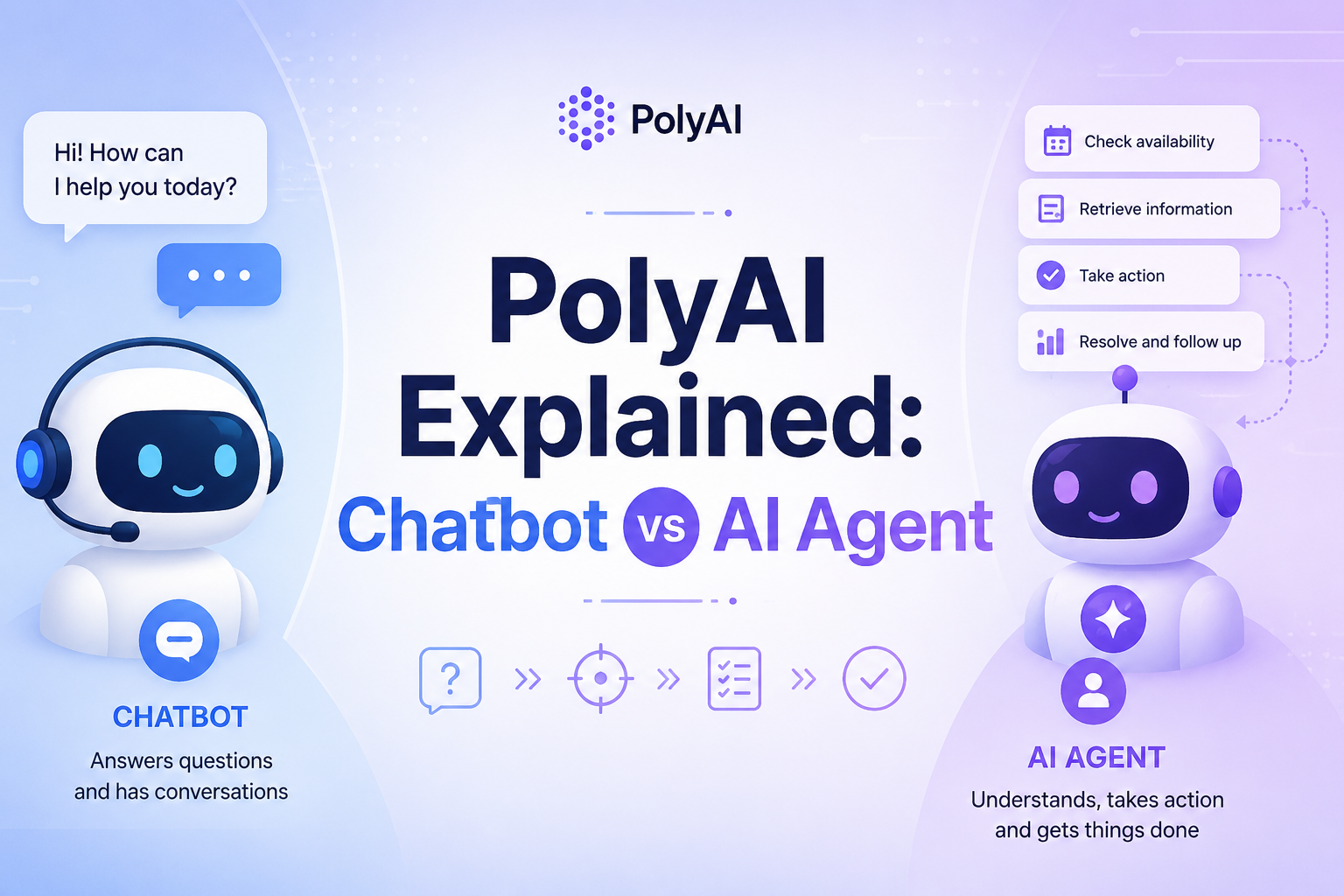
Most chatbots frustrate us. PolyAI is built to change that — with voice-first AI that listens, understands, and actually resolves problems, not just deflects them.
We have all been there. You call a company’s helpline, get greeted by a robotic voice that says “Press 1 for billing, press 2 for support,” and spend the next ten minutes being bounced between menus before finally screaming “Agent!” into the phone. The chatbot era promised to fix this. Mostly, it has not. But a London-based company called PolyAI is making a serious case that the problem was never AI itself — it was how we were building it.
PolyAI is not just another chatbot company. It is a voice AI platform that builds customer-facing voice assistants so natural, so contextually aware, and so capable of handling real complexity, that many callers do not realise they are talking to a machine at all. That is a bold claim — so let us examine exactly what sets PolyAI apart from the conventional chatbots and IVR (interactive voice response) systems that have defined customer service automation for the past decade. If you are interested in how AI models are being optimised for real-world deployment at the edge, our deep-dive on Gemma 4 optimisation for Edge AI and local deployment is a great companion read.
01 The Core Problem with Normal Chatbots
Before understanding PolyAI, it helps to understand what is broken about traditional chatbots. Most rule-based or even early AI chatbots operate on a simple principle: they match what you say to a predetermined list of intents, then serve a scripted response. This works well for narrow, predictable queries. Ask “What are your opening hours?” and the bot does fine. Ask something messy, multi-part, or off-script, and the system collapses — producing the dreaded “I’m sorry, I didn’t understand that” loop.
- Rigid, menu-driven flows
- Limited to scripted intents
- Fail on complex queries
- No memory across turns
- Robotic, unnatural voice
- High escalation rates
- Open-ended, natural conversation
- Handles complex multi-part queries
- Context-aware across the call
- Human-like prosody and tone
- Resolves issues end-to-end
- Deeply integrated with back-end systems
The second problem is voice quality. Text-based chatbots have their own issues, but voice bots historically sound unmistakably mechanical — unnatural pauses, monotone delivery, inability to handle interruptions. This immediately signals to callers that they are stuck in an automated system, which raises frustration before the conversation has even begun.
02 PolyAI’s Voice-First Philosophy
PolyAI was founded in 2017 by researchers from the University of Cambridge’s Dialogue Systems Group, which means its DNA is in deep linguistic research, not customer service software. That heritage matters. The company was built around a fundamental conviction: voice is the most natural interface humans have, and AI should meet people there — not force them to adapt to a machine’s limitations.
This voice-first approach means PolyAI invests heavily in speech synthesis and recognition that goes far beyond what standard platforms offer. Their voice agents can handle natural interruptions (when a caller talks over the bot), recover gracefully from background noise, understand regional accents and informal speech patterns, and maintain a conversational cadence that feels genuinely human. These are hard problems that most chatbot platforms treat as edge cases. PolyAI treats them as table stakes.
03 What Actually Makes It Different
Natural Voice Quality
Human-like prosody, emotional range, and the ability to handle interruptions without breaking the flow.
Deep NLU
Goes beyond keyword matching — understands intent, context, and nuance across multi-turn conversations.
Back-End Integration
Connects to CRMs, booking systems, and databases to actually resolve issues, not just collect information.
High Containment
Resolves the majority of calls without human escalation — the true measure of a capable voice agent.
Perhaps the most important differentiator is what PolyAI calls containment rate — the percentage of calls fully resolved by the AI without needing a human agent. Traditional IVR systems achieve containment by deflection: forcing callers down narrow paths until they give up or find a number to press. PolyAI achieves containment through genuine resolution, which is an entirely different thing. When a caller’s issue is actually solved, they hang up satisfied. When they are merely deflected, they call back — angrier.
04 Real-World Performance
PolyAI’s enterprise clients span hospitality, retail, financial services, healthcare, and telecommunications. A major hotel chain using PolyAI’s voice assistant can let guests call to book rooms, modify reservations, ask about amenities, or request upgrades — all handled by the AI with live access to the property management system. A restaurant group can take table reservations across dozens of locations simultaneously, with zero hold time and a voice that matches the brand’s warm, welcoming tone. These are not simple FAQ bots. They are fully functional customer service agents.
05 The Human-AI Handoff — Done Right
Even the best AI cannot handle everything. What separates PolyAI from lesser systems is the intelligence of its handoff. When a PolyAI voice agent encounters a call it cannot resolve — a genuinely unusual complaint, a highly emotional caller, or a complex edge case — it does not simply drop the customer into a queue and start over. It passes a complete, structured summary of the conversation to the human agent, so the caller never has to repeat themselves. This single feature eliminates one of the most infuriating experiences in customer service: re-explaining your problem from scratch to every new person you are transferred to.
The handoff is also intelligent about when to escalate — not triggering on a raised voice alone, but recognising genuine resolution failure. This avoids both the frustration of too-early escalations that waste human capacity, and too-late ones that leave callers feeling trapped.
06 Why This Matters for the Future
PolyAI is part of a broader shift in how we think about AI in customer experience. For years, automation in this space meant cost-cutting through deflection — getting fewer calls to human agents by any means necessary. PolyAI represents a different philosophy: automation through genuine capability. According to Gartner research, conversational AI is set to become a primary customer service channel — but only platforms that resolve rather than deflect will earn lasting adoption. If an AI can handle a complex call better than an overworked human agent operating from a script, everyone wins — the customer, the company, and the human agents who are freed to handle the calls that truly need their empathy and judgement. The same principle of running capable AI closer to the action is explored in our article on Gemma 4 optimisation for Edge AI — where low-latency, on-device inference is proving transformative.
↗ The Verdict
What makes PolyAI different from normal chatbots is not one single feature — it is a fundamentally different design philosophy. Where most chatbots ask “how do we automate the script?”, PolyAI asks “how do we make AI good enough at conversation that the script becomes irrelevant?” That shift in framing changes everything: the technology, the use cases, the outcomes, and the experience for every person who calls.
The frustrating chatbot is not an inevitable feature of modern customer service. PolyAI is proof that with the right research foundation, the right voice technology, and the right definition of success, AI can be genuinely good at talking to people.
And when AI gets good at talking to people, the possibilities for business — and for human experience — become extraordinary.
≈ 1,300 words

No responses yet